
Consider the following for this Question : Two circles with centres at $O_1$ and $O_2$ touching each other are placed inside a rectangle of sides 9 cm and 8 cm as shown in the figure given below.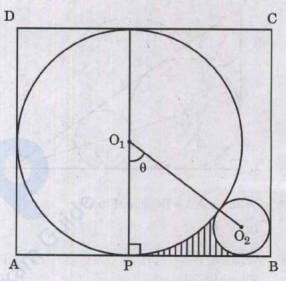
Which one of the following is correct in respect of angle $\theta$?
To solve the given problem, we must consider the geometrical arrangement mentioned in the question, involving two touching circles within a rectangle.
The rectangle has sides of 9 cm and 8 cm. Since the two circles are touching each other and are placed such that the line connecting their centers is parallel to the width of the rectangle (8 cm), the combined diameter of these two circles must be less than or equal to 8 cm.
To find the relation of angle \theta, we analyze the orientation. Since they are within the rectangle and touch each other, the angle of inclination that includes both radii meeting at a point must be considered.
If we consider the problem geometrically, the tightest placement of two circles that touch inside a rectangle would mean the line joining their centers would form angle \theta with one of the sides of the rectangle. For maximum utilization of space, this angle \theta would be close to, but less than, a right angle.
This would suggest a scenario where \theta is within the range of 60^\circ < \theta < 90^\circ.
Thus, the correct answer is 60^\circ < \theta < 90^\circ.
Conclusion: The angle \theta should be between 60° and 90°, considering the arrangement and orientation of the circles within the given rectangle. This matches the given correct answer.
Similar Questions
What is the approximate area of the triangle ABC?
What is the angle made by the line joining the centre of the sphere and any point on the rim of the circular opening with a vertical line passing through the centre?
What is the area of the square?
What is the area of triangle CDE?
What is the area of the overlapping region?
What is the area of the non-overlapping region?
- The area of the circle circumscribing three identical circles touching each other is \(\frac{\pi(2+\sqrt{3})^2}{3}\) square cm. What is the radius of one of the smaller circles?
What is the length of MN?
What is the length of the side of the triangle ABC?
- The difference between the two acute angles in a right-angled triangle is \(\frac{\pi}{12}\) radian. One of the acute angles of the triangle is
Important Questions from Geometry
If the angles of a triangle are in the ratio of 2:3:4, then the difference of the measure of greatest angle and smallest angle is
In ΔABC, ∠A = 90°, AD ┴ BC and AD = BD = 2 cm. The length of CD is
How many lines of symmetry does a rectangle have?
The number of diagonals in each face a cube is
Which of the following is/are the geometric figures with the line of symmetry?
I. Rectangle
II. Isosceles triangle



