
Question
Which of the following statements about the human auditory system is/are CORRECT?
Auditory System: Statement Analysis
This section analyzes the provided statements about the human auditory system to determine which are correct.
Statement Analysis
- Statement 1: Sound waves are converted to mechanical movements in the inner ear.
This statement is incorrect. While the inner ear (cochlea) contains structures that convert mechanical vibrations into nerve signals, the initial conversion of sound waves into mechanical movements primarily occurs in the middle ear (ossicles) and involves the vibration of the tympanic membrane. - Statement 2: Organ of Corti is located in the inner ear.
This statement is CORRECT. The Organ of Corti, which houses the sensory hair cells responsible for detecting sound vibrations, is situated within the cochlea, a part of the inner ear. - Statement 3: The middle bone in the middle ear is called incus.
This statement is CORRECT. The middle ear contains three small bones (ossicles): the malleus, the incus, and the stapes. The incus, commonly known as the anvil, is the middle ossicle, connecting the malleus to the stapes. - Statement 4: Tympanic membrane is also known as the oval window.
This statement is incorrect. The tympanic membrane, or eardrum, is located at the end of the ear canal and vibrates when struck by sound waves. The oval window is a separate structure, an opening into the inner ear, through which the stapes transmits vibrations.
Conclusion
Based on the analysis, statements 2 and 3 are correct descriptions related to the human auditory system.
Was this answer helpful?
Important Questions from Biological Basis of Behaviour Sensory Systems
Match the numbered parts of the vocal tract (in the diagram given below) with the correct label from those given in the box and choose the appropriate option.
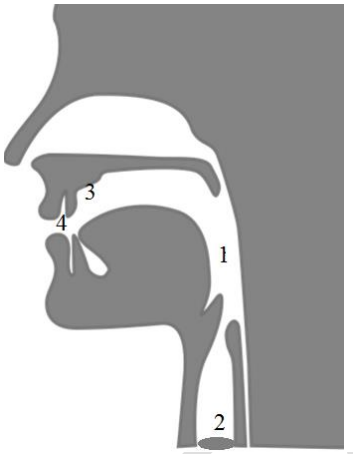
LABELS
a. Labial cavity
b. Pharyngeal cavity
c. Alveolar ridge
d. Laryngeal cavity- In the Darwinian sense, ________ refers to the ability of an organism to survive and produce a large number of fertile offspring.
- Comparing the thoughts of Heraclitus and Parmenides, we can say that:
- In his Yogasūtra, Patañjali mentions five kinds of afflictions (kleśas). Which one of the following is NOT among the five afflictions?
- Devanagari organizes the consonant graphemes as shown in the image. What is the parameter by which the following two rows differ?
क ख ग घ ङ /k/ /kʰ/ /g/ /gʰ/ /ŋ/ प फ ब भ म /p/ /pʰ/ /b/ /bʰ/ /m/
Need Expert Advice?


