
क ख ग घ ङ /k/ /kʰ/ /g/ /gʰ/ /ŋ/ प फ ब भ म /p/ /pʰ/ /b/ /bʰ/ /m/
Devanagari Consonant Organization Analysis
Devanagari script organizes consonants based on phonetic features. The question highlights two distinct rows:
- Row 1: क ख ग घ ङ (IPA: $k$, $k^h$, $g$, $g^h$, $\eta$)
- Row 2: प फ ब भ म (IPA: $p$, $p^h$, $b$, $b^h$, $m$)
The goal is to identify the phonetic parameter that defines the difference between these two rows.
Analyzing Potential Distinguishing Parameters
We evaluate each option based on the sounds represented:
- Voicing: Row 1 includes voiceless ($k$, $k^h$) and voiced ($g$, $g^h$) sounds. Row 2 also has voiceless ($p$, $p^h$) and voiced ($b$, $b^h$) sounds. Thus, voicing is present in both rows but isn't the primary distinguishing feature between them.
- Manner of Articulation: All consonants in both rows are stops (plosives). The manner of articulation is the same for both series.
- Place of Articulation:
- Row 1 (क-ङ) represents sounds produced at the velar place (near the soft palate).
- Row 2 (प-म) represents sounds produced at the labial place (using the lips).
- Aspiration: Both rows contain pairs of aspirated (e.g., $k^h$, $g^h$, $p^h$, $b^h$) and unaspirated sounds (e.g., $k$, $g$, $p$, $b$). Aspiration is a secondary feature within the series, not the primary difference between the rows.
Conclusion: Identifying the Key Difference
The fundamental phonetic characteristic separating the क-ङ series (velars) from the प-म series (labials) is the Place of Articulation.
Important Questions from Biological Basis of Behaviour Sensory Systems
Match the numbered parts of the vocal tract (in the diagram given below) with the correct label from those given in the box and choose the appropriate option.
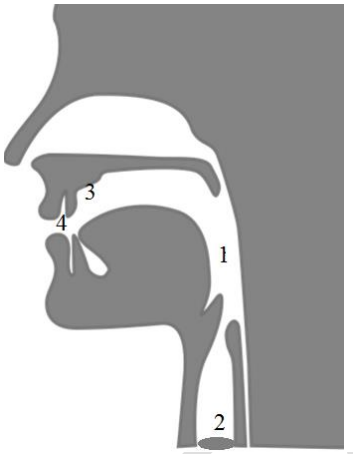
LABELS
a. Labial cavity
b. Pharyngeal cavity
c. Alveolar ridge
d. Laryngeal cavity- In the Darwinian sense, ________ refers to the ability of an organism to survive and produce a large number of fertile offspring.
- Comparing the thoughts of Heraclitus and Parmenides, we can say that:
- In his Yogasūtra, Patañjali mentions five kinds of afflictions (kleśas). Which one of the following is NOT among the five afflictions?
- Which of the following sound pairs differ from each other in exactly two articulatory parameters?


