
[P] Affected individuals, but not their progeny, can be cured through germline gene therapy
[Q] Affected individuals, as well as their progeny, can be cured through germline gene therapy
[R] Affected individuals, but not their progeny, can be cured through somatic gene therapy
[S] Affected individuals, as well as their progeny, can be cured through somatic gene therapy
Gene Therapy: Germline vs. Somatic Statements
This explanation analyzes the key differences between germline and somatic gene therapy to determine the correctness of the provided statements.
Somatic Gene Therapy Explained
- Focus: Targets the somatic cells (body cells) of an individual.
- Effect: Modifications affect only the treated individual. These changes are not passed down to offspring.
- Statement Analysis: Consequently, somatic gene therapy can cure affected individuals, but their progeny will not be affected by the therapy. This makes statement [R] correct and statement [S] incorrect.
Germline Gene Therapy Explained
- Focus: Targets the germ cells (sperm or egg cells) or the cells of an early embryo.
- Effect: Modifications are incorporated into the genetic makeup and are heritable, meaning they can be passed on to future generations (progeny).
- Statement Analysis: Therefore, germline gene therapy has the potential to cure affected individuals and also prevent the condition in their progeny. This makes statement [Q] correct and statement [P] incorrect.
Conclusion on Statements
Based on the distinct characteristics of each type of gene therapy:
- Statement [Q] accurately describes germline gene therapy's impact on individuals and their progeny.
- Statement [R] accurately describes somatic gene therapy's impact on individuals without affecting progeny.
Statements [Q] and [R] are the correct descriptions.
Important Questions from Genetic Disorders
Match the genetic disorder (Column I) with its molecular basis (Column II)
Column I Column II P. Sickle-cell anemia 1. Mutation in nucleotide excision repair Q. Xeroderma pigmentosum 2. Trisomy of chromosome 21 R. Tay-Sachs disease 3. Mutation in $ \beta$-globin gene S. Down Syndrome 4. Mutation in hexosaminidase A gene A pedigree of an inheritable disease is shown below.
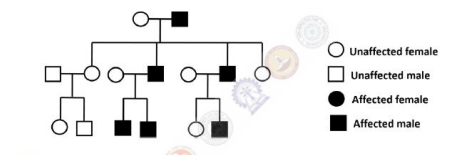
This inheritable disease is- Match the genetic disorders in Column I to the corresponding underlying cause in Column II
Column I Column II P. Klinefelter Syndrome 1. X-chromosome insufficiency Q. Turner syndrome 2. DNA helicase mutations R. Bloom syndrome 3. Nucleotide excision repair defects S. Xeroderma pigmentosum 4. Extra X chromosome(s) in a male


