
Question
A pedigree of an inheritable disease is shown below.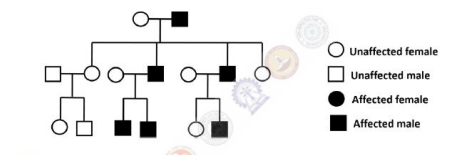
This inheritable disease is
The correct answer is
only Y-linked
To determine the pattern of inheritance shown in the pedigree, let's analyze the given chart step-by-step.
In this pedigree:
- Squares represent males, and circles represent females.
- Shaded symbols indicate individuals affected by the disease.
Let's assess the possible inheritance patterns:
- X-linked Dominant: In X-linked dominant inheritance, affected males pass the trait to all of their daughters, who will all be affected, but none of their sons. This pattern is not observed here.
- X-linked Recessive or Y-linked:
- X-linked Recessive: Typically more males are affected, and affected females would have affected fathers and carrier or affected mothers. Not fitting well here.
- Y-linked: Only males are affected and passed from father to son. This fits our pattern.
- Only Y-linked: Here, affected fathers pass the trait to all of their sons and none of their daughters. Observing the chart, this pattern matches perfectly.
- Only X-linked Recessive: Affected females would need an affected father, not matching the observed pattern, and usually affects more males.
Conclusion: The pedigree shows that the disease is passed from father to son and affects males only, matching only the Y-linked pattern. Thus, the disease is only Y-linked.
Was this answer helpful?
Important Questions from Genetic Disorders
Match the genetic disorder (Column I) with its molecular basis (Column II)
Column I Column II P. Sickle-cell anemia 1. Mutation in nucleotide excision repair Q. Xeroderma pigmentosum 2. Trisomy of chromosome 21 R. Tay-Sachs disease 3. Mutation in $ \beta$-globin gene S. Down Syndrome 4. Mutation in hexosaminidase A gene - Which of the following statements about gene therapy are CORRECT?
[P] Affected individuals, but not their progeny, can be cured through germline gene therapy
[Q] Affected individuals, as well as their progeny, can be cured through germline gene therapy
[R] Affected individuals, but not their progeny, can be cured through somatic gene therapy
[S] Affected individuals, as well as their progeny, can be cured through somatic gene therapy - Match the genetic disorders in Column I to the corresponding underlying cause in Column II
Column I Column II P. Klinefelter Syndrome 1. X-chromosome insufficiency Q. Turner syndrome 2. DNA helicase mutations R. Bloom syndrome 3. Nucleotide excision repair defects S. Xeroderma pigmentosum 4. Extra X chromosome(s) in a male
Need Expert Advice?


