
Match the genetic disorder (Column I) with its molecular basis (Column II)Column I Column II P. Sickle-cell anemia 1. Mutation in nucleotide excision repair Q. Xeroderma pigmentosum 2. Trisomy of chromosome 21 R. Tay-Sachs disease 3. Mutation in $ \beta$-globin gene S. Down Syndrome 4. Mutation in hexosaminidase A gene
Matching Genetic Disorders to Molecular Basis
This question requires matching specific genetic disorders with their underlying molecular causes. Let's analyze each disorder:
P. Sickle-cell Anemia Basis
Sickle-cell anemia is characterized by the abnormal shape of red blood cells. This is caused by a specific point mutation in the gene that codes for the beta-globin chain of hemoglobin. Therefore, Sickle-cell anemia matches with: 3. Mutation in $ \beta $-globin gene.
Q. Xeroderma Pigmentosum Basis
Xeroderma pigmentosum is a condition leading to extreme sensitivity to sunlight due to defects in DNA repair mechanisms. Specifically, it involves deficiencies in the nucleotide excision repair pathway, which repairs DNA damage caused by UV radiation. Thus, Xeroderma pigmentosum matches with: 1. Mutation in nucleotide excision repair.
R. Tay-Sachs Disease Basis
Tay-Sachs disease results from the accumulation of lipids in nerve cells due to a deficiency in the enzyme hexosaminidase A. This deficiency is caused by mutations in the gene responsible for producing this enzyme. Therefore, Tay-Sachs disease matches with: 4. Mutation in hexosaminidase A gene.
S. Down Syndrome Basis
Down Syndrome is a genetic disorder associated with specific physical characteristics and developmental delays. It is caused by the presence of an extra full or partial copy of chromosome 21. This condition is known as Trisomy 21. Hence, Down Syndrome matches with: 2. Trisomy of chromosome 21.
Consolidated Matching
Based on the analysis above, the correct matching is:
- P - 3
- Q - 1
- R - 4
- S - 2
This corresponds to the option P-3; Q-1; R-4; S-2.
Important Questions from Genetic Disorders
- Which of the following statements about gene therapy are CORRECT?
[P] Affected individuals, but not their progeny, can be cured through germline gene therapy
[Q] Affected individuals, as well as their progeny, can be cured through germline gene therapy
[R] Affected individuals, but not their progeny, can be cured through somatic gene therapy
[S] Affected individuals, as well as their progeny, can be cured through somatic gene therapy A pedigree of an inheritable disease is shown below.
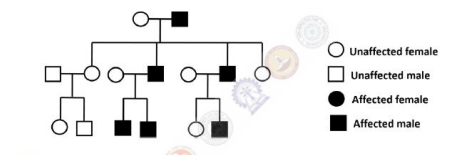
This inheritable disease is- Match the genetic disorders in Column I to the corresponding underlying cause in Column II
Column I Column II P. Klinefelter Syndrome 1. X-chromosome insufficiency Q. Turner syndrome 2. DNA helicase mutations R. Bloom syndrome 3. Nucleotide excision repair defects S. Xeroderma pigmentosum 4. Extra X chromosome(s) in a male


