
Column I Column II P. Klinefelter Syndrome 1. X-chromosome insufficiency Q. Turner syndrome 2. DNA helicase mutations R. Bloom syndrome 3. Nucleotide excision repair defects S. Xeroderma pigmentosum 4. Extra X chromosome(s) in a male
Genetic Disorders Matching
This question requires matching genetic disorders listed in Column I with their specific underlying causes found in Column II.
Klinefelter Syndrome Cause
P. Klinefelter Syndrome is characterized by a male having an extra X chromosome, resulting in a karyotype typically represented as $47, XXY$. This directly corresponds to the cause: 4. Extra X chromosome(s) in a male.
Turner Syndrome Cause
Q. Turner syndrome affects females and is characterized by the absence of one X chromosome, leading to a karyotype typically represented as $45, X$. This signifies an insufficiency or loss of an X chromosome, matching the cause: 1. X-chromosome insufficiency.
Bloom Syndrome Cause
R. Bloom syndrome is a rare genetic disorder caused by mutations in the *BLM* gene. The BLM protein is a DNA helicase crucial for DNA repair and replication. Therefore, its cause is: 2. DNA helicase mutations.
Xeroderma Pigmentosum Cause
S. Xeroderma pigmentosum is a disorder marked by extreme sensitivity to UV radiation due to defective DNA repair mechanisms. Specifically, it involves defects in the Nucleotide Excision Repair (NER) pathway. This matches the cause: 3. Nucleotide excision repair defects.
Summary of Matches
The correct matches are:
- P matched with 4
- Q matched with 1
- R matched with 2
- S matched with 3
This corresponds to option P-4; Q-1; R-2; S-3.
| Column I | Column II | Match |
|---|---|---|
| P. Klinefelter Syndrome | 4. Extra X chromosome(s) in a male | P-4 |
| Q. Turner syndrome | 1. X-chromosome insufficiency | Q-1 |
| R. Bloom syndrome | 2. DNA helicase mutations | R-2 |
| S. Xeroderma pigmentosum | 3. Nucleotide excision repair defects | S-3 |
Important Questions from Genetic Disorders
Match the genetic disorder (Column I) with its molecular basis (Column II)
Column I Column II P. Sickle-cell anemia 1. Mutation in nucleotide excision repair Q. Xeroderma pigmentosum 2. Trisomy of chromosome 21 R. Tay-Sachs disease 3. Mutation in $ \beta$-globin gene S. Down Syndrome 4. Mutation in hexosaminidase A gene - Which of the following statements about gene therapy are CORRECT?
[P] Affected individuals, but not their progeny, can be cured through germline gene therapy
[Q] Affected individuals, as well as their progeny, can be cured through germline gene therapy
[R] Affected individuals, but not their progeny, can be cured through somatic gene therapy
[S] Affected individuals, as well as their progeny, can be cured through somatic gene therapy A pedigree of an inheritable disease is shown below.
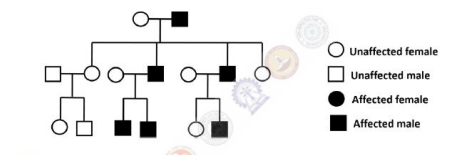
This inheritable disease is


