
Superposition Theorem Applicability
The Superposition theorem is a fundamental concept in electrical circuit analysis. It simplifies the analysis of complex circuits with multiple independent sources.
Theorem Principle
- The theorem states that the total voltage or current in any part of a linear network is the algebraic sum of the voltages or currents produced by each independent source acting alone.
- Crucially, when considering each source individually, all other independent sources are deactivated (voltage sources replaced by short circuits, current sources by open circuits).
Conditions for Application
The application of the Superposition theorem is restricted to circuits that exhibit specific properties:
- Linearity: The circuit elements must obey Ohm's law and Kirchhoff's laws, meaning their voltage-current relationship is linear. This implies elements like resistors, capacitors, and inductors behave predictably.
- Bilaterality: The elements should be bilateral, meaning they behave the same way regardless of the direction of current flow. This is typically true for passive components like resistors.
Circuits containing non-linear elements (e.g., diodes, transistors) cannot be analyzed using the superposition theorem because the response is not directly proportional to the input/source strength.
Analysis of Options
- Option 1 & 2: Incorrect. The theorem requires linearity, not exclusively active or passive elements. It works with a mix as long as the circuit is linear.
- Option 4: Incorrect. The presence of non-linear elements prevents the use of the superposition theorem.
- Option 3: Correct. The theorem is applicable specifically to circuits composed of linear bilateral elements, as this ensures the superposition principle holds true.
Conclusion
Therefore, the Superposition theorem is correctly applied only to circuits containing linear bilateral elements.
Important Questions from Network Theorems
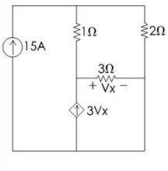
The power supplied by the dependent source in the figure is,
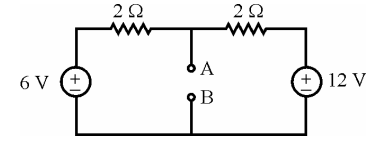
The Thevenin's equivalent across AB is
Which equivalent circuits are dual ?
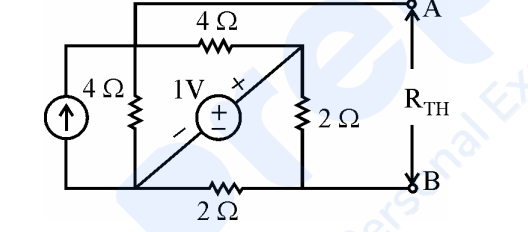
For the n/w, find RTH
The principle of superposition is the property of


