
Understanding Plate Tectonics Processes
Plate tectonics describes the large-scale motion of Earth's lithosphere. Several geological phenomena are direct results of this movement.
Processes Linked to Plate Tectonics
- Subduction: This occurs when one tectonic plate moves under another, often leading to volcanic activity and earthquakes. It's a fundamental process at convergent plate boundaries.
- Mountain Building (Orogenesis): The collision of tectonic plates (continental-continental convergence) directly causes the crust to fold and fault, creating mountain ranges like the Himalayas.
- Sea Floor Spreading: At divergent plate boundaries (mid-ocean ridges), new oceanic crust is formed as tectonic plates move apart, and magma rises to fill the gap.
Identifying the Unrelated Process
A mantle plume is a conceptual column of exceptionally hot rock rising from the deep mantle (potentially the core-mantle boundary) towards the Earth's surface. While mantle plumes can cause volcanic activity (like the Hawaiian Islands) and influence the crust above, their origin and primary driving mechanism are considered distinct from the horizontal movements and interactions that define plate tectonics. They are related to deep mantle convection, not directly to the shearing, colliding, or separating of lithospheric plates.
Conclusion
Based on the direct mechanisms, the rise of mantle plume is the process least directly related to the fundamental definition and operation of plate tectonics compared to subduction, mountain building, and sea floor spreading.
Important Questions from Plate Tectonics
- The Paleo-Tethys Sea once separated
- Andean-type mountain belts form in
- Which of the following rock suits generally characterizes a plate boundary?
- In the table given below, indentify the correct pair
Plate boundary Type Example A. Oceanic Divergent F. San Andreas fault B. Continental Divergent G. Himalaya C. Oceanic-Continental convergence H. Mid Atlantic Ridge D. Continent-Continent convergence I. East African Rift E. Transform J. Andes 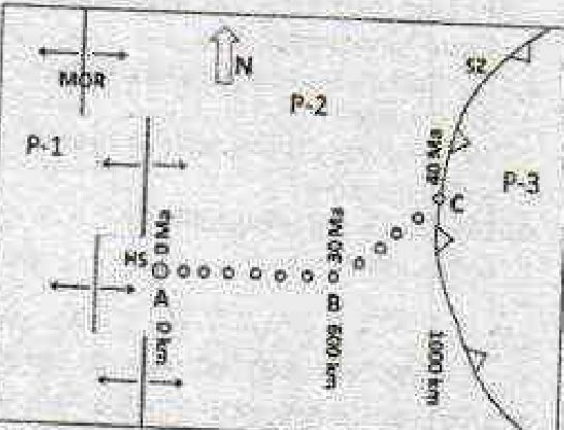
The above diagram shows a schematic planar configuration of three tectonic plates P-1, P-2 and P-3 and two plate boundaries at a spreading ridge (MOR) and subduction zone. A-B-C is a 1000km long hot spot track formed over a hotspot (HS) and for a period of 40 Myr. The ages of the volcanoes on the track would yield which one of the following relationships against their distances from the current location of the hotspot?


