
Andean-type Mountain Belts Formation Explained
Andean-type mountain belts are formed at convergent plate boundaries where one tectonic plate slides beneath another, a process known as subduction.
Specifically, they occur where oceanic lithosphere subducts beneath continental lithosphere. This type of boundary is called an oceanic-continental convergent boundary.
The subduction process generates magma that rises to the surface, forming volcanoes and a mountain range parallel to the continental edge. This volcanic mountain range is termed a continental arc. The Andes Mountains are a prime example.
Therefore, Andean-type mountain belts develop in the context of continental arcs.
Important Questions from Plate Tectonics
- The Paleo-Tethys Sea once separated
- Which of the following rock suits generally characterizes a plate boundary?
- In the table given below, indentify the correct pair
Plate boundary Type Example A. Oceanic Divergent F. San Andreas fault B. Continental Divergent G. Himalaya C. Oceanic-Continental convergence H. Mid Atlantic Ridge D. Continent-Continent convergence I. East African Rift E. Transform J. Andes - Which of the following processes is not related to plate tectonics?
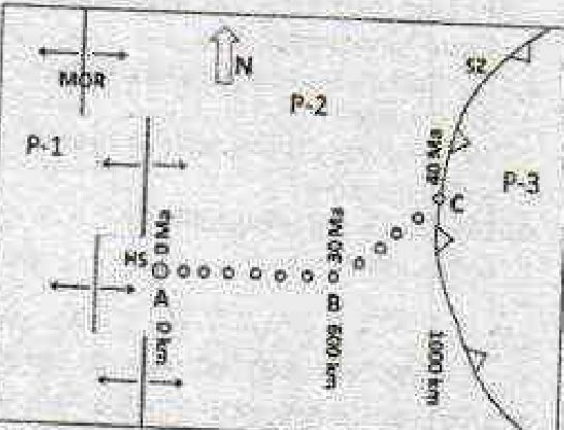
The above diagram shows a schematic planar configuration of three tectonic plates P-1, P-2 and P-3 and two plate boundaries at a spreading ridge (MOR) and subduction zone. A-B-C is a 1000km long hot spot track formed over a hotspot (HS) and for a period of 40 Myr. The ages of the volcanoes on the track would yield which one of the following relationships against their distances from the current location of the hotspot?


