
Paleo-Tethys Sea Geographic Role
The Paleo-Tethys Sea was a significant ancient ocean that played a crucial role in the separation of major continental landmasses during the Paleozoic and Mesozoic eras.
Understanding Continental Separation
During geological history, Earth's continents have shifted and broken apart. The Paleo-Tethys Sea acted as a barrier between specific large continental regions.
Identifying Separated Landmasses
The Paleo-Tethys Sea specifically separated the northern supercontinent of Laurasia from the southern supercontinent of Gondwanaland.
- Laurasia comprised present-day North America, Europe, and Asia (excluding India).
- Gondwanaland included present-day South America, Africa, Antarctica, Australia, and India.
Therefore, the Paleo-Tethys Sea was the body of water situated between these two major continental blocks.
Important Questions from Plate Tectonics
- Andean-type mountain belts form in
- Which of the following rock suits generally characterizes a plate boundary?
- In the table given below, indentify the correct pair
Plate boundary Type Example A. Oceanic Divergent F. San Andreas fault B. Continental Divergent G. Himalaya C. Oceanic-Continental convergence H. Mid Atlantic Ridge D. Continent-Continent convergence I. East African Rift E. Transform J. Andes - Which of the following processes is not related to plate tectonics?
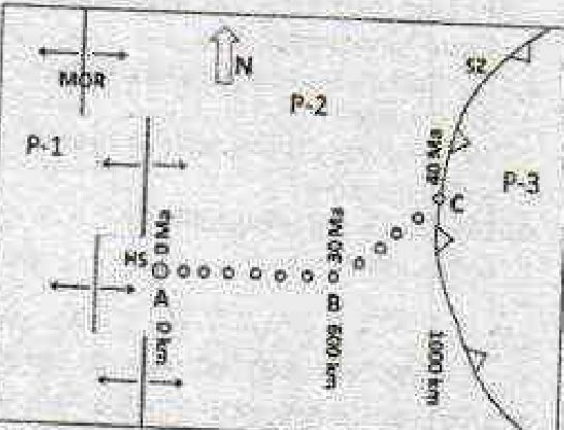
The above diagram shows a schematic planar configuration of three tectonic plates P-1, P-2 and P-3 and two plate boundaries at a spreading ridge (MOR) and subduction zone. A-B-C is a 1000km long hot spot track formed over a hotspot (HS) and for a period of 40 Myr. The ages of the volcanoes on the track would yield which one of the following relationships against their distances from the current location of the hotspot?


