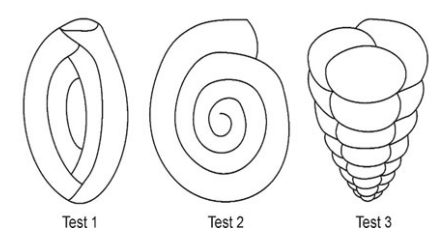
Statement for Linked Answer Questions Microfossils are widely used in palaeoceanographic studies.
Microfossil Groups Below Carbonate Compensation Depth
The Carbonate Compensation Depth (CCD) is the ocean depth where the dissolution rate of calcium carbonate (CaCO3) equals the supply rate. Below the CCD, calcareous materials dissolve, while siliceous materials remain intact.
We need to identify the microfossil group that typically exists in deep sea sediments *below* the CCD.
Microfossil Composition and Survival Below CCD
- Radiolaria: These are protozoa with intricate siliceous skeletons (made of silica, SiO2). Silica is resistant to dissolution in seawater, even at high pressures and low temperatures found below the CCD. Therefore, Radiolaria tests accumulate in deep-sea sediments.
- Foraminifera: These are typically single-celled organisms with calcareous shells (made of CaCO3). These shells dissolve readily below the CCD.
- Cocoliths: These are microscopic plates formed by Cocolithophores (a type of phytoplankton) also composed of CaCO3. Like foraminifera shells, they dissolve below the CCD.
- Ostracods: These are small crustaceans with bivalve shells, usually made of CaCO3. While some may be found deeper, their calcareous shells are susceptible to dissolution below the CCD.
Conclusion on Deep Sea Microfossils
Based on their siliceous composition, which resists dissolution below the Carbonate Compensation Depth, Radiolaria are the microfossil group generally found in deep sea sediments below the CCD.
| Microfossil Group | Composition | Occurrence Below CCD |
| Radiolaria | Siliceous (SiO2) | Common |
| Foraminifera | Calcareous (CaCO3) | Rare / Dissolves |
| Cocoliths | Calcareous (CaCO3) | Rare / Dissolves |
| Ostracods | Calcareous (CaCO3) | Rare / Dissolves |
Important Questions from Paleobiology (Microfossils: Foraminifera, Ostracoda, etc.)
- Which of the following microfossils has/have a geological range from Cambrian to Recent?
- Which of the following microfossils is/are foraminifera?
- Which of the following statement(s) is/are correct?
- Which one of the following microfossils is commonly used in biostratigraphic correlation of Palaeozoic marine strata?
Choose the CORRECT combination of foraminiferal tests and types of coiling.