
Analyzing Biological Statements
The question asks to identify the correct statements about various biological organisms.
Statement Evaluation
-
Statement 1: Diatoms are algal forms.
This statement is correct. Diatoms are a major group of single-celled algae, recognized for their intricate silica cell walls (frustules).
-
Statement 2: Dinoflagellates are unicellular algae.
This statement is correct. Dinoflagellates are typically unicellular protists, often photosynthetic and classified within algae. They possess distinctive flagella.
-
Statement 3: Petropods are planktic gastropods.
This statement is correct. Pteropods, commonly called sea butterflies, are pelagic (free-swimming) gastropod molluscs that drift in ocean currents.
-
Statement 4: Radiolarians are organic-walled microfossils.
This statement is incorrect. Radiolarians are unicellular protozoa famous for their complex skeletons, which are typically made of silica, not organic material. While they form microfossils, their primary structure isn't organic-walled.
Conclusion on Correct Statements
Based on the analysis, statements 1, 2, and 3 are correct. Statement 4 is incorrect.
Important Questions from Paleobiology (Microfossils: Foraminifera, Ostracoda, etc.)
- Which of the following microfossils has/have a geological range from Cambrian to Recent?
- Which of the following microfossils is/are foraminifera?
- Which one of the following microfossils is commonly used in biostratigraphic correlation of Palaeozoic marine strata?
Choose the CORRECT combination of foraminiferal tests and types of coiling.
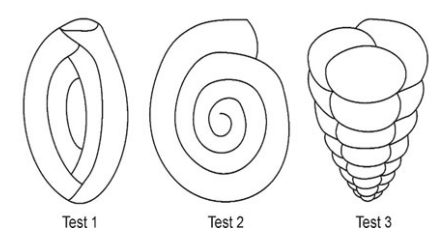
- Match foraminifera in Group I with its wall structure in Group II
Group I Group II P. Fusulina 1. Hyaline Q. Cibicides 2. Porcellaneous R. Textularia 3. Microgranular S. Quinqueloculina 4. Agglutinated


