
Question
Which one of the following microfossils is commonly used in biostratigraphic correlation of Palaeozoic marine strata?
The correct answer is
Chitinozoans
Palaeozoic Biostratigraphic Correlation Using Microfossils
Biostratigraphic correlation uses fossils to date and match rock layers. For Palaeozoic marine strata, specific microfossils are particularly useful due to their abundance, wide distribution, and rapid evolution.
Analysis of Microfossil Options
- Angiosperm pollen: Primarily found in younger strata (Mesozoic and Cenozoic), not typically used for Palaeozoic correlation.
- Diatoms: Mostly Cenozoic age, common in marine and freshwater sediments, but not characteristic of the Palaeozoic.
- Dinoflagellates: Appear later than the Palaeozoic, becoming significant in the Mesozoic.
- Chitinozoans: These are small, organic-walled microfossils that originated in the Ordovician period and persisted through the Devonian into the Carboniferous. They are abundant in many Palaeozoic marine environments and are excellent index fossils for biostratigraphic correlation during this time.
Conclusion
Based on their stratigraphic range and environmental association, Chitinozoans are the microfossils most commonly used for biostratigraphic correlation of Palaeozoic marine strata.
Was this answer helpful?
Important Questions from Paleobiology (Microfossils: Foraminifera, Ostracoda, etc.)
- Which of the following microfossils has/have a geological range from Cambrian to Recent?
- Which of the following microfossils is/are foraminifera?
- Which of the following statement(s) is/are correct?
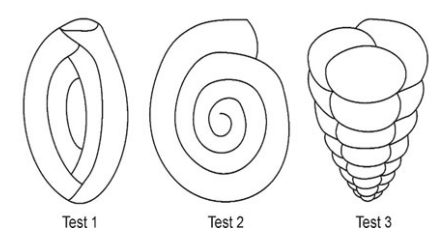
Choose the CORRECT combination of foraminiferal tests and types of coiling.
- Match foraminifera in Group I with its wall structure in Group II
Group I Group II P. Fusulina 1. Hyaline Q. Cibicides 2. Porcellaneous R. Textularia 3. Microgranular S. Quinqueloculina 4. Agglutinated
Need Expert Advice?


