
Which of the following law states that “whenever the magnetic flux linked with a conductor or coil changes, an emf is induced in it?
Faraday’s first law of electromagnetic induction
Understanding Electromagnetic Induction Laws
The question asks which law states that an electromotive force (emf) is induced in a conductor or coil when the magnetic flux linked with it changes. This phenomenon is known as electromagnetic induction.
Exploring the Laws of Electromagnetic Induction
Let's look at the laws mentioned in the options to identify the correct one:
- Fleming’s right hand rule: This rule is used to determine the direction of the induced current when a conductor moves in a magnetic field or when the magnetic field changes around a stationary conductor. It relates the direction of motion, the magnetic field direction, and the induced current direction. It doesn't state that an emf is induced due to changing flux, but rather helps find the direction of the current resulting from that induction in specific scenarios.
- Faraday’s first law of electromagnetic induction: This law is fundamental to understanding electromagnetic induction. It states that whenever there is a change in the magnetic flux ($\Phi$) linked with a coil or conductor, an emf is induced in it. This induced emf lasts only as long as the change in magnetic flux continues. This statement perfectly matches the description given in the question.
- Lenz’s law: This law provides the direction of the induced emf or induced current. It states that the direction of the induced current is such that it opposes the very cause that produces it, which is the change in magnetic flux. While related to induced emf, it focuses on the direction of the effect, not the condition for induction itself.
- Faraday’s second law of electromagnetic induction: This law quantifies the induced emf. It states that the magnitude of the induced emf is directly proportional to the rate of change of magnetic flux linked with the circuit. Mathematically, this can be expressed as $\mathcal{E} = -N \frac{d\Phi}{dt}$, where $\mathcal{E}$ is the induced emf, $N$ is the number of turns in the coil, and $\frac{d\Phi}{dt}$ is the rate of change of magnetic flux. While crucial for calculating the emf, it describes the magnitude based on the *rate* of change, not simply the condition that a change induces emf.
Identifying the Correct Law
Based on the analysis:
- Fleming's right hand rule and Lenz's law deal with the direction of the induced current or emf.
- Faraday's second law deals with the magnitude of the induced emf based on the rate of flux change.
- Faraday's first law explicitly states the condition for the induction of emf: a change in magnetic flux.
Therefore, the law that states that an emf is induced whenever the magnetic flux linked with a conductor or coil changes is Faraday’s first law of electromagnetic induction.
Important Questions from Faraday's Law
In the table shown, List I and List II, respectively, contain terms appearing on the left-hand side and the right-hand side of Maxwell’s equations (in their standard form). Match the left-hand side with the corresponding right-hand side.
List I
List II
1.
∇. D
P
0
2.
∇ × E
Q
\(\rho_v\)
3.
∇. B
R
\( - \frac{{\partial B}}{{\partial t}}\)
4.
∇ × H
S
\(J+ \frac{{\partial D}}{{\partial t}}\)
“By the motion of the conductor or the coil in a magnetic field, i.e., the magnetic field is stationary and the moving conductors cut through it. The EMF generated in this way is normally called dynamically induced EMF.”
The given statement is specified by which of the following laws?
A flux of 0.25 mWb is produced by a coil of 1000 turns wound on a ring with a current of 2 A in it. Calculate the e.m.f induced in the coil when a current of 10 A is switched off, assuming the current will fall to zero in 1 millisecond.
All induction type transducers are based on
The figure shows an arbitrarily shaped planar conducting loop A in the XY plane. Two nonintersecting regions with areas $a_1$ and $a_2$ within the loop are subjected to magnetic fields $\vec{B}_1 = \frac{m}{\sqrt{2}} \sin(\omega t) (1\hat{x} + 0\hat{y} + 1\hat{z})$, and
$\vec{B}_2 = -\frac{n}{\sqrt{2}} \cos(2\omega t + \pi/4) (0\hat{x} + 1\hat{y} + 1\hat{z})$, respectively.
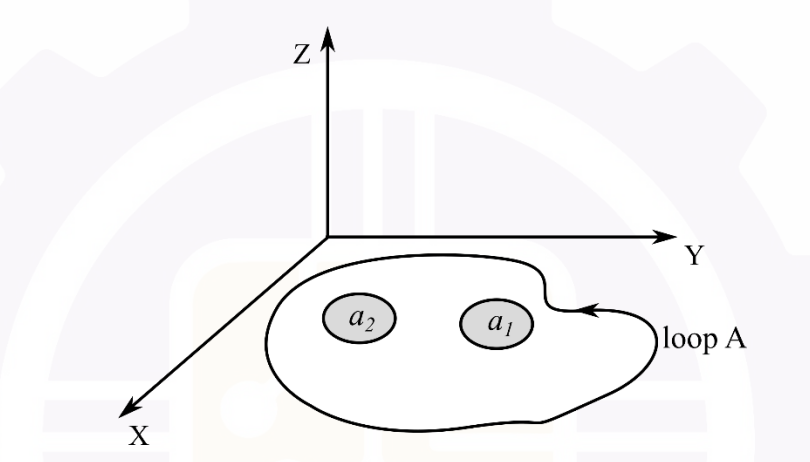
What is the expression for the induced rms voltage in loop A?


