
“By the motion of the conductor or the coil in a magnetic field, i.e., the magnetic field is stationary and the moving conductors cut through it. The EMF generated in this way is normally called dynamically induced EMF.” The given statement is specified by which of the following laws?
Faraday’s second law
Understanding Dynamically Induced EMF and Faraday's Laws
The question describes the generation of Electromotive Force (EMF) through the relative motion between a conductor and a magnetic field. When a conductor moves within a magnetic field, or a magnetic field changes around a stationary conductor, a voltage (EMF) is induced in the conductor. This process is known as electromagnetic induction.
There are two primary ways EMF is induced:
- Statically induced EMF: Occurs when a changing magnetic field links with a stationary conductor (e.g., in transformers).
- Dynamically induced EMF: Occurs when a conductor moves through a stationary magnetic field, or when a changing magnetic field is caused by the motion of a magnet relative to a stationary conductor (as described in the question). This involves the conductor cutting through the magnetic flux lines.
The generation of this induced EMF is governed by Faraday's laws of electromagnetic induction.
Faraday's Laws of Electromagnetic Induction
Faraday's work laid the foundation for understanding how electricity can be generated from magnetism. His laws can be summarized as follows:
-
Faraday's First Law: This law states that an EMF is induced in a conductor whenever there is a change in the magnetic flux linkage with the conductor. The change in magnetic flux can be caused by:
- Relative motion between the conductor and the magnetic field (as described in the question - dynamically induced EMF).
- Changing the strength of the magnetic field.
Essentially, the first law tells us that an EMF is induced when the magnetic flux changes.
-
Faraday's Second Law: This law quantifies the induced EMF. It states that the magnitude of the induced EMF is directly proportional to the rate of change of magnetic flux linkage with the coil or circuit. Mathematically, it is expressed as:
\[ \mathcal{E} = -N \frac{d\Phi_B}{dt} \]
Where:
- \( \mathcal{E} \) is the induced EMF.
- \( N \) is the number of turns in the coil (for a single conductor, \( N=1 \)).
- \( \frac{d\Phi_B}{dt} \) is the rate of change of magnetic flux (\( \Phi_B \)) with respect to time (\( t \)).
- The negative sign indicates the direction of the induced EMF/current (explained by Lenz's Law).
This law is crucial because it tells us *how much* EMF is induced based on how quickly the magnetic flux is changing.
Relating the Question to Faraday's Second Law
The question describes the generation of EMF by the relative motion between a conductor and a stationary magnetic field, stating this results in "dynamically induced EMF". This motion causes the conductor to cut through magnetic flux lines, which is a direct way of changing the magnetic flux linked with the conductor over time. While the first law states that EMF is induced when flux changes, the second law quantifies this induction by stating the magnitude of the induced EMF is proportional to the *rate* at which this flux changes due to the relative motion.
Therefore, the statement in the question describing the physical process that generates dynamically induced EMF aligns with the principles described by Faraday's laws, particularly the second law which defines the magnitude of the induced EMF based on the rate of flux change resulting from the relative motion.
Kirchhoff's laws relate to the conservation of energy and charge in electrical circuits (junction rule and loop rule) and do not directly explain the fundamental process of electromagnetic induction described in the question.
Lenz's law is a consequence of Faraday's law and specifies the direction of the induced current or EMF, stating it opposes the change that produces it. It does not explain *how* or *why* the EMF is induced, but rather its direction.
Given the context of EMF generation through relative motion and its classification as dynamically induced EMF, Faraday's laws are the relevant principles. While the first law describes the condition for induction (change in flux due to motion), the second law provides the quantitative relationship for the magnitude of this induced EMF based on the rate of change of flux caused by that motion.
Important Questions from Faraday's Law
In the table shown, List I and List II, respectively, contain terms appearing on the left-hand side and the right-hand side of Maxwell’s equations (in their standard form). Match the left-hand side with the corresponding right-hand side.
List I
List II
1.
∇. D
P
0
2.
∇ × E
Q
\(\rho_v\)
3.
∇. B
R
\( - \frac{{\partial B}}{{\partial t}}\)
4.
∇ × H
S
\(J+ \frac{{\partial D}}{{\partial t}}\)
A flux of 0.25 mWb is produced by a coil of 1000 turns wound on a ring with a current of 2 A in it. Calculate the e.m.f induced in the coil when a current of 10 A is switched off, assuming the current will fall to zero in 1 millisecond.
Which of the following law states that “whenever the magnetic flux linked with a conductor or coil changes, an emf is induced in it?
All induction type transducers are based on
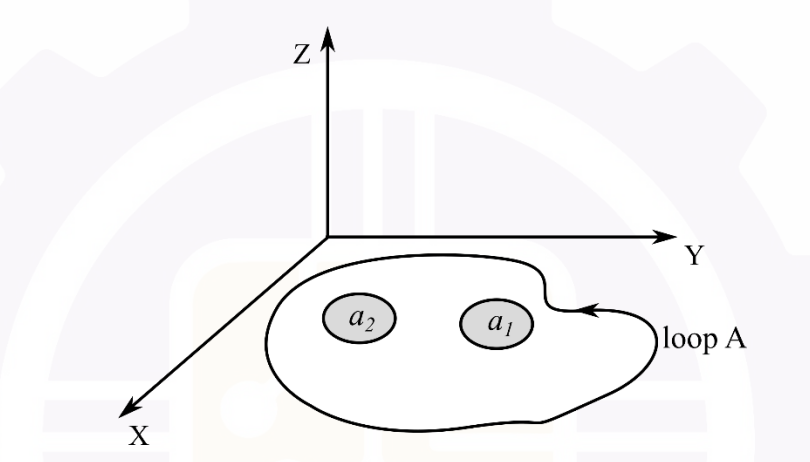
The figure shows an arbitrarily shaped planar conducting loop A in the XY plane. Two nonintersecting regions with areas $a_1$ and $a_2$ within the loop are subjected to magnetic fields $\vec{B}_1 = \frac{m}{\sqrt{2}} \sin(\omega t) (1\hat{x} + 0\hat{y} + 1\hat{z})$, and
$\vec{B}_2 = -\frac{n}{\sqrt{2}} \cos(2\omega t + \pi/4) (0\hat{x} + 1\hat{y} + 1\hat{z})$, respectively.
What is the expression for the induced rms voltage in loop A?


