
Question
Which of the following is TRUE in case of Substitution theorem?
The correct answer is
The initial condition of the rest of the circuit remains same, if a network element is replaced by a voltage source having an equal voltage as the voltage across the element at every instant of time.
Substitution Theorem Explained
The Substitution theorem is a fundamental concept in circuit analysis. It applies to linear networks.
Key Principle of Substitution Theorem
- The theorem states that if a network element is replaced by a voltage source (or current source), the rest of the circuit remains unchanged only if the voltage source has a voltage equal to the original voltage across the element at every instant, or the current source has a current equal to the original current through the element at every instant.
- Crucially, this means the initial conditions of the rest of the circuit are preserved.
Analysis of Options
- Option 1 & 4: Incorrect because they state initial conditions change, contradicting the theorem. Option 4 also incorrectly relates voltage to current.
- Option 2: Incorrect because it incorrectly links replacing an element with a voltage source having 'equal current as the voltage' and states initial conditions change.
- Option 3: Correct. It accurately states that replacing a network element with a voltage source having an equal voltage across it at every instant ensures the initial conditions of the rest of the circuit remain the same.
Therefore, the statement that correctly describes the Substitution theorem regarding initial conditions is Option 3.
Was this answer helpful?
Important Questions from Network Theorems
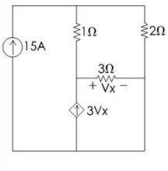
The power supplied by the dependent source in the figure is,
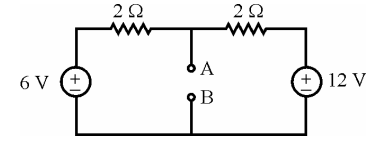
The Thevenin's equivalent across AB is
Which equivalent circuits are dual ?
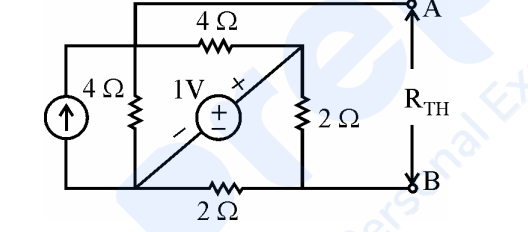
For the n/w, find RTH
The principle of superposition is the property of
Need Expert Advice?


