Which of the following is the zero of the polynomial p(x) = $3x^3$ - $6x^2$ - 5x + 10?
2
Grouping: 3x^3-6x^2-5x+10 = 3x^2(x-2) - 5(x-2) = (x-2)(3x^2-5). Setting p(x)=0 gives x=2 as a rational zero (the other roots ±sqrt(5/3) are irrational and not listed).
Similar Questions
Three identical solid cubes of side 2 cm each are placed one over another to form a cuboid. What is the volume of the resulting cuboid?
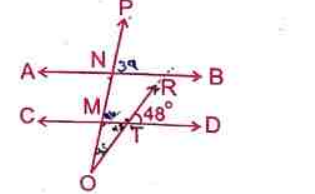
In the given figure AB || CD. MT = MO, m∠RTD = 48°. m∠PNB = 3x then, what is the value of x?
In the given figure, two straight lines E-A-C-F and R-A-B-P intersect at A above the line M-B-C-N (M, B, C, N collinear). If m∠BCF = 110°, m∠MBP = x°, and m∠BAE = 2x°, find the value of m∠ABC.
In ΔABC, m∠A = 54°, m∠B = 62°, m∠C = 64°. If the lengths of the sides of the triangle are arranged in ascending order, then which of the following is true?
x ∝ $y^2$ $z^3$, if y and z both are doubled then how many times will be the value of x?
If 2 + 2(x+1 + 2(x+2) = 112 then find the value of x?
If x + y = 3 and $x^2$ + $y^2$ = 5 then find the value of $x^4$ + $y^4$:
What is the third proportional of $a^3$- $b^3$ + ab (a-b) and $a^2$ - $b^2$?
If $x^2$ + x + 1 = 0, then find the value of $x^3$+ $\frac{1}{x^3}$.
In the given figure, four straight lines AB, CD, EF and GH pass through a common central region, intersecting one another at points R, O, S, M, P and T (line AB passes through R, O, T in that order; line GH passes through R, M, S in that order; line CD passes through C, O, P, S, D in that order; line EF passes through E, M, P, T, F in that order). Given m angle GRO = 120 degrees, MS = MP, and m angle RMT = 90 degrees, find the measure of angle COT.
Important Questions from Miscellaneous
Which of the following is NOT a state function or state variable in a thermodynamic system?
- What is the full form for "BPL" in Socio-economic aspects?
- In October 2024, which of the following companies was awarded the contract for design, manufacturing and commissioning of two high-speed trainsets by Integral Coach Factory (ICF) to be used in India's first bullet train between Mumbai and Ahmedabad?
- Which of the following methods of reproduction simply involves the splitting of the parent cell into two daughter cells in the bacteria?
- A, B, C and D opened shopping complexes in the same city. The shopping complex of A is 6 km west of the shopping complex of B. The shopping complex of C is 4 km north of the shopping complex of B. The shopping complex of D is 6 km west of the shopping complex of C. In which direction is the shopping complex of D from the shopping complex of A?