Three identical solid cubes of side 2 cm each are placed one over another to form a cuboid. What is the volume of the resulting cuboid?
$24 cm^3$
To solve this problem, we must first understand the configuration and dimensions of the solid shapes involved.
We are given that we have three identical solid cubes, each with a side length of 2 cm. The cubes are placed one over another to form a cuboid.
The volume of a cube is given by the formula:
V_{\text{cube}} = a^3, where a is the side length of the cube.
Substituting the given side length of the cube, we have:
V_{\text{cube}} = (2 \, \text{cm})^3 = 8 \, \text{cm}^3
Since three cubes are stacked to form the cuboid, the dimensions of the resulting cuboid become:
- Length = 2 cm (same as the side of a cube)
- Breadth = 2 cm (same as the side of a cube)
- Height = 3 × 2 cm = 6 cm (because three cubes are stacked vertically)
Now, the volume of the cuboid is calculated using the formula:
V_{\text{cuboid}} = \text{Length} \times \text{Breadth} \times \text{Height}
Substituting the measurements:
V_{\text{cuboid}} = 2 \, \text{cm} \times 2 \, \text{cm} \times 6 \, \text{cm} = 24 \, \text{cm}^3
Therefore, the volume of the resulting cuboid is 24 \, \text{cm}^3.
Upon analysis of the options given:
- 8 \, \text{cm}^3: This is the volume of a single cube, not the cuboid.
- 16 \, \text{cm}^3: This is not correct as it doesn't account for stacking three cubes.
- 24 \, \text{cm}^3: This matches our calculated volume of the cuboid.
- 32 \, \text{cm}^3: This is incorrect based on our calculations.
Thus, the correct answer is 24 \, \text{cm}^3.
Similar Questions
How many lines of symmetry does an equilateral triangle have?
A motor car takes 50 seconds to travel 500 meters. What is its speed in km/h?
A solid sphere is melted and recast into 8 equal smaller spheres. What will be the radius of each smaller sphere?
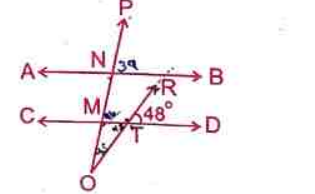
In the given figure AB || CD. MT = MO, m∠RTD = 48°. m∠PNB = 3x then, what is the value of x?
In the given figure, two straight lines E-A-C-F and R-A-B-P intersect at A above the line M-B-C-N (M, B, C, N collinear). If m∠BCF = 110°, m∠MBP = x°, and m∠BAE = 2x°, find the value of m∠ABC.
In ΔABC, m∠A = 54°, m∠B = 62°, m∠C = 64°. If the lengths of the sides of the triangle are arranged in ascending order, then which of the following is true?
If x + y = 3 and $x^2$ + $y^2$ = 5 then find the value of $x^4$ + $y^4$:
If 2 + 2(x+1 + 2(x+2) = 112 then find the value of x?
x ∝ $y^2$ $z^3$, if y and z both are doubled then how many times will be the value of x?
Which of the following is the zero of the polynomial p(x) = $3x^3$ - $6x^2$ - 5x + 10?
Important Questions from Miscellaneous
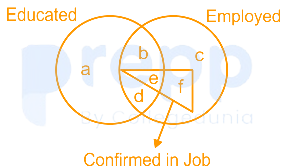
Read the given figure and find the region representing persons who are educated and employed but not confirmed in job.
The magazine in which Mahatma Gandhi mentioned what he wanted the Constitution to do is:
Which gas shields the surface of the earth from ultraviolet radiation from the sun?
Which event is marked as an Intangible Cultural Heritage of Humanity by UNESCO?
Who has been conferred with the rank of the Commander of the Order of the British Empire in 2018?