
Identifying Non-Network Theorem for AC/DC Circuits
Network theorems are essential tools for simplifying complex electrical circuits, allowing for easier analysis of voltages and currents. Several fundamental theorems are widely used for both AC and DC circuit problems. We will examine each option to determine which one does not fit this category.
Superposition Theorem Applicability
The Superposition Theorem is applicable to linear circuits containing multiple sources. It states that the response (current or voltage) in any part of a linear circuit is the algebraic sum of the responses caused by each individual source, acting independently. This theorem is valid for both AC and DC circuits.
Norton's Theorem Applicability
Norton's Theorem provides an equivalent circuit for a complex network, simplifying it to a single current source in parallel with a single impedance (or resistance for DC circuits). This equivalent circuit behaves identically to the original network concerning any load connected to its terminals. It is applicable to both AC and DC linear networks.
Reciprocity Theorem Applicability
The Reciprocity Theorem applies to linear, bilateral networks. It states that if a voltage source 'V' in one branch produces a current 'I' in another branch, then the same voltage source 'V' acting in the second branch will produce the same current 'I' in the first branch. This theorem is useful for analyzing reciprocal networks in both AC and DC systems.
Parseval's Theorem Role
Parseval's Theorem is primarily used in signal processing and Fourier analysis. It relates the total energy or average power of a signal to its frequency components. Specifically, it allows the calculation of the total energy (for transient signals) or average power (for periodic signals) by integrating the square of the signal's magnitude over time or by integrating the square of its frequency spectrum. While it can be used to calculate power in AC circuits, especially those with non-sinusoidal waveforms, it is not a network simplification theorem like the others. It does not directly simplify the circuit structure or solve for specific branch currents or node voltages through topological reduction.
Conclusion
Superposition, Norton's, and Reciprocity theorems are standard network simplification and analysis tools applicable to AC/DC circuits. Parseval's Theorem, however, is fundamentally a theorem about signal energy and power related to frequency content, rather than a method for solving network parameters through circuit reduction.
Important Questions from Network Theorems
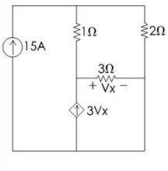
The power supplied by the dependent source in the figure is,
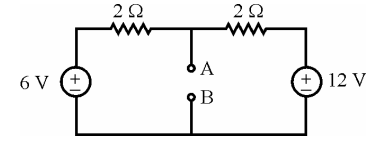
The Thevenin's equivalent across AB is
Which equivalent circuits are dual ?
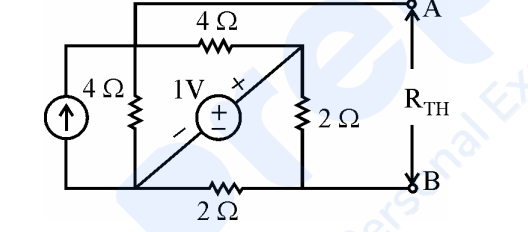
For the n/w, find RTH
The principle of superposition is the property of


