
Which of the following is not a characteristic of enzymes?
Non-specific
Understanding Enzyme Characteristics
Enzymes are biological catalysts, usually proteins, that speed up chemical reactions within living organisms. They are essential for most biochemical processes. Enzymes possess several key characteristics that define how they function. Let's examine the properties listed in the options to determine which one is not a characteristic of enzymes.
Analysis of Enzyme Properties
- Non-specific: This statement suggests that enzymes can act on many different types of molecules. However, enzymes are known for their high degree of specificity. Most enzymes catalyze only one specific reaction or act on only one specific substrate. This specificity arises from the unique three-dimensional structure of the enzyme's active site, which complements the shape of the substrate molecule, much like a key fits into a specific lock (the lock-and-key model) or induces a conformational change to fit (the induced-fit model). Therefore, being "non-specific" is generally not a characteristic of enzymes.
- Active at optimum pH: Enzymes have an optimal pH range where their activity is highest. Deviations from this optimum pH, whether more acidic or more alkaline, can alter the enzyme's structure and affect its active site, leading to reduced activity or even denaturation (irreversible loss of function). Thus, activity at an optimum pH is a true characteristic of enzymes.
- Affected by inhibitors: The activity of enzymes can be regulated by other molecules. Inhibitors are substances that bind to an enzyme and decrease its activity. This is a crucial mechanism for controlling metabolic pathways in cells. Therefore, enzymes being affected by inhibitors is a characteristic.
- Highly efficient: Enzymes are remarkably efficient catalysts. They can increase the rate of a reaction by factors ranging from a million to over a trillion times compared to the uncatalyzed reaction. They achieve this by lowering the activation energy required for the reaction to proceed. This high efficiency is a defining feature of enzymes.
Summary of Enzyme Characteristics
Based on the analysis, most enzymes exhibit high specificity, operate optimally within a specific pH range, are affected by inhibitors, and are highly efficient catalysts.
| Characteristic | Description | Is it typical? |
|---|---|---|
| Specificity | Usually acts on one or a few closely related substrates/reactions. | Yes (Highly specific) |
| Optimum Conditions | Works best at specific temperature and pH ranges. | Yes (Optimum pH/Temperature) |
| Regulation | Activity can be increased (activators) or decreased (inhibitors). | Yes (Affected by inhibitors) |
| Efficiency | Significantly lowers activation energy, speeding up reactions. | Yes (Highly efficient) |
The statement "Non-specific" contradicts the fundamental property of enzyme specificity. While some enzymes show a degree of group specificity (acting on molecules with similar functional groups), the general characteristic is high specificity, not non-specificity.
Revision Table: Key Enzyme Properties
| Property | Explanation |
|---|---|
| Specificity | Enzymes are typically specific, binding to particular substrates at their active site. |
| Optimum Activity Conditions | Enzymes function optimally at specific temperature and pH values. Extreme conditions can cause denaturation. |
| Regulation by Inhibitors/Activators | Enzyme activity can be controlled by molecules that bind to them, either decreasing (inhibitors) or increasing (activators) their rate. |
| Catalytic Efficiency | Enzymes dramatically speed up reaction rates by lowering activation energy without being consumed in the process. |
Additional Information on Enzyme Specificity
Enzyme specificity can be categorized into different types:
- Absolute Specificity: The enzyme catalyzes only one reaction with one specific substrate (e.g., Lactase hydrolyzing only lactose).
- Group Specificity: The enzyme acts only on molecules that have specific functional groups, such as amino, phosphate, or methyl groups (e.g., Hexokinase phosphorylates various hexose sugars).
- Linkage Specificity: The enzyme acts on a particular type of chemical bond, regardless of the rest of the molecular structure (e.g., Peptidases breaking peptide bonds in proteins).
- Stereochemical Specificity: The enzyme acts on a particular stereoisomer (e.g., L-amino acid oxidase acts only on L-amino acids).
This variety exists, but the general principle is that enzymes are selective in their action, which is the opposite of being "non-specific".
Important Questions from Haloalkanes and Haloarenes
Which of the following haloalkanes reacts with aqueous KOH most easily?
Which of the following alkyl halides will undergo SN1 reaction most readily?
What will be the product for the following reactions?
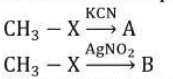
From the following, choose the ones which are not secondary haloalkanes:
(A) 2-Bromopentane
(B) 1-Bromo-3-methylbutane
(C) 3-Bromopentane
(D) 2-Bromo-2-methylbutane
(E) 2-Bromo-3-methylbutane
Choose the correct answer from the options given below:
2-Bromopentane is heated with alcoholic KOH. Which is the correct statement for this reaction?
A. Only pent-2-ene is formed.
B. Only pent-1-ene is formed.
C. Both pent-2-ene and pent-1-ene are formed.
D. Pent-2-ene will be the major product as it is more stable.
Choose the correct answer from the options given below:


