
Which of the following haloalkanes reacts with aqueous KOH most easily?
2-Bromo-2-methylpropane
Understanding Haloalkane Reactions with Aqueous KOH
When haloalkanes react with aqueous potassium hydroxide (KOH), the hydroxide ion (OH-) from KOH can act as a strong nucleophile or a strong base. This can lead to two main types of reactions: nucleophilic substitution (where the halogen is replaced by an -OH group) or elimination (where an alkene is formed).
The ease with which a haloalkane reacts depends largely on its structure (whether it is primary, secondary, or tertiary) and the nature of the halogen (which acts as the leaving group).
Types of Haloalkanes in the Options
Let's classify the given haloalkanes based on the carbon atom bonded to the halogen:
- 1-Bromobutane: The bromine atom is attached to a primary carbon (a carbon bonded to only one other carbon).
- 2-Bromobutane: The bromine atom is attached to a secondary carbon (a carbon bonded to two other carbons).
- 2-Bromo-2-methylpropane: The bromine atom is attached to a tertiary carbon (a carbon bonded to three other carbons). This is also known as tert-butyl bromide.
- 2-Chlorobutane: The chlorine atom is attached to a secondary carbon.
Influence of Haloalkane Structure and Leaving Group on Reactivity
Nucleophilic substitution reactions often proceed via two main mechanisms: SN1 and SN2.
- SN1 Mechanism: This involves the formation of a carbocation intermediate. The rate-determining step is the dissociation of the haloalkane to form a carbocation and a leaving group. The stability of the carbocation is crucial. Tertiary carbocations are the most stable, followed by secondary, then primary. Therefore, SN1 reactivity follows the order: Tertiary > Secondary > Primary. Protic solvents (like water in aqueous KOH) favor SN1 by stabilizing the carbocation and the leaving group.
- SN2 Mechanism: This is a concerted reaction where the nucleophile attacks the carbon from the backside, simultaneously displacing the leaving group. Steric hindrance around the carbon atom is a major factor. Primary haloalkanes have the least steric hindrance, making them most reactive via SN2. Reactivity follows the order: Primary > Secondary > Tertiary.
Elimination reactions (E1 and E2) can also occur, especially E1 in conditions favoring carbocation formation (like SN1 conditions for tertiary haloalkanes) and E2 with a strong base (like OH-).
The leaving group ability also affects the reaction rate in both substitution and elimination reactions. A good leaving group stabilizes the negative charge it carries upon leaving. Halides are common leaving groups, and their ability increases down the group: I- > Br- > Cl- > F-. Bromine is a better leaving group than chlorine.
Analyzing Each Haloalkane Option with Aqueous KOH
Let's consider the reactivity of each option with aqueous KOH:
- 1-Bromobutane (Primary bromide): Primary haloalkanes primarily react via the SN2 pathway with a strong nucleophile/base like OH-. Elimination (E2) is also possible but less favored for primary substrates under these conditions compared to substitution.
- 2-Bromobutane (Secondary bromide): Secondary haloalkanes can undergo both SN1/E1 and SN2/E2 reactions. With a strong nucleophile/base in a protic solvent, a mixture of products from both substitution and elimination is often observed. The reactivity is intermediate compared to primary and tertiary.
- 2-Bromo-2-methylpropane (Tertiary bromide): Tertiary haloalkanes react very slowly, if at all, via SN2 due to steric hindrance. However, they readily form stable tertiary carbocations. With aqueous KOH (a protic solvent and strong nucleophile/base), tertiary haloalkanes react rapidly via SN1 and E1 pathways.
- 2-Chlorobutane (Secondary chloride): This is a secondary haloalkane like 2-Bromobutane. However, chlorine is a poorer leaving group than bromine. Therefore, its reactivity via any mechanism (SN1, SN2, E1, E2) is expected to be slower than the corresponding bromide.
Why 2-Bromo-2-methylpropane Reacts Most Easily
Comparing the options, the tertiary haloalkane, 2-Bromo-2-methylpropane, stands out because it can form a highly stable tertiary carbocation. In the presence of a protic solvent like water (from aqueous KOH), this carbocation formation step (which is rate-determining for SN1 and E1) is relatively fast. The subsequent steps (attack by nucleophile for SN1 or proton abstraction for E1) are also rapid. Primary haloalkanes react via SN2, which is generally fast but often slower than the facile SN1 reaction of a tertiary halide in a protic solvent. Secondary halides are typically less reactive than tertiary halides in SN1 and less reactive than primary halides in SN2.
Furthermore, the options include both bromides and a chloride. Bromides are more reactive than chlorides due to bromine being a better leaving group.
Considering both structure and leaving group ability, 2-Bromo-2-methylpropane (tertiary bromide) is the most likely to react most easily with aqueous KOH, primarily via SN1 and E1 mechanisms.
Revision Table: Haloalkane Reactivity Factors
| Haloalkane Type | Favored Substitution Mechanism(s) | Relative SN1 Reactivity (Protic Solvent) | Relative SN2 Reactivity | Likely Reaction with Aqueous KOH |
|---|---|---|---|---|
| Primary (RCH2X) | SN2 | Least Reactive | Most Reactive | Primarily SN2 |
| Secondary (R2CHX) | SN1, SN2 | Intermediate | Intermediate | Mixture of SN1, SN2, E1, E2 |
| Tertiary (R3CX) | SN1 | Most Reactive (via stable carbocation) | Least Reactive (due to steric hindrance) | Primarily SN1 and E1/E2 |
Additional Information on Haloalkane Reactions
The specific conditions (solvent, temperature, strength and concentration of nucleophile/base) play a significant role in determining whether substitution (SN1/SN2) or elimination (E1/E2) predominates. Aqueous KOH provides both a strong nucleophile (OH-) and a protic solvent (water).
- Solvent Effects: Protic solvents (like water, alcohols) favor SN1 and E1 by stabilizing the transition state and intermediates (carbocations, leaving groups) through hydrogen bonding. Aprotic solvents (like DMSO, acetone) favor SN2 by not solvating the nucleophile as strongly, making it more reactive.
- Nucleophile/Base Strength: Strong, small nucleophiles/bases (like OH-, CH3O-) favor SN2 and E2. Weak nucleophiles/bases (like H2O, ROH) favor SN1 and E1 (if a stable carbocation can form).
- Temperature: Higher temperatures generally favor elimination over substitution.
In the case of tertiary haloalkanes like 2-bromo-2-methylpropane with aqueous KOH, the formation of the stable tertiary carbocation is rapid in the protic solvent, leading to fast SN1 and E1 reactions. While elimination is often significant for tertiary halides with strong bases, the SN1 substitution pathway is also very efficient and contributes to the overall ease of reaction compared to the other options under these conditions.
Important Questions from Haloalkanes and Haloarenes
Which of the following is not a characteristic of enzymes?
Which of the following alkyl halides will undergo SN1 reaction most readily?
What will be the product for the following reactions?
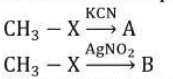
From the following, choose the ones which are not secondary haloalkanes:
(A) 2-Bromopentane
(B) 1-Bromo-3-methylbutane
(C) 3-Bromopentane
(D) 2-Bromo-2-methylbutane
(E) 2-Bromo-3-methylbutane
Choose the correct answer from the options given below:
2-Bromopentane is heated with alcoholic KOH. Which is the correct statement for this reaction?
A. Only pent-2-ene is formed.
B. Only pent-1-ene is formed.
C. Both pent-2-ene and pent-1-ene are formed.
D. Pent-2-ene will be the major product as it is more stable.
Choose the correct answer from the options given below:


