
Which of the following alkyl halides will undergo SN1 reaction most readily?
(CH3)3C-I
The SN1 reaction involves the formation of a carbocation intermediate. The ability of the alkyl halide to undergo this reaction depends on the ability of the leaving group to stabilize the carbocation. In this case, **iodide (I-)** is the best leaving group, making **(CH3)3C-I** the most reactive in the SN1 reaction. The leaving group ability decreases in the order: I- > Br- > Cl- > F-. Therefore, the correct answer is **option (d)**.
Important Questions from Haloalkanes and Haloarenes
Which of the following haloalkanes reacts with aqueous KOH most easily?
Which of the following is not a characteristic of enzymes?
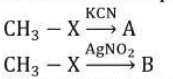
What will be the product for the following reactions?
From the following, choose the ones which are not secondary haloalkanes:
(A) 2-Bromopentane
(B) 1-Bromo-3-methylbutane
(C) 3-Bromopentane
(D) 2-Bromo-2-methylbutane
(E) 2-Bromo-3-methylbutane
Choose the correct answer from the options given below:
2-Bromopentane is heated with alcoholic KOH. Which is the correct statement for this reaction?
A. Only pent-2-ene is formed.
B. Only pent-1-ene is formed.
C. Both pent-2-ene and pent-1-ene are formed.
D. Pent-2-ene will be the major product as it is more stable.
Choose the correct answer from the options given below:


