
2-Bromopentane is heated with alcoholic KOH. Which is the correct statement for this reaction? A. Only pent-2-ene is formed. B. Only pent-1-ene is formed. C. Both pent-2-ene and pent-1-ene are formed. D. Pent-2-ene will be the major product as it is more stable. Choose the correct answer from the options given below:
C, D only
Understanding 2-Bromopentane and Alcoholic KOH Reaction
The reaction involves 2-bromopentane treated with alcoholic potassium hydroxide (KOH). Alcoholic KOH is a strong base commonly used to carry out elimination reactions, specifically dehydrohalogenation, on alkyl halides.
Dehydrohalogenation of 2-Bromopentane
Dehydrohalogenation is the removal of a hydrogen atom (H) and a halogen atom (Br) from adjacent carbon atoms, resulting in the formation of an alkene. In 2-bromopentane, the bromine atom is attached to the second carbon. For elimination to occur, a hydrogen atom must be removed from a carbon adjacent to the carbon bearing the bromine (the β-carbon).
In 2-bromopentane, there are two possible sets of β-carbons and thus β-hydrogens that can be removed:
- Carbon 1 (primary β-carbon) has hydrogens.
- Carbon 3 (secondary β-carbon) has hydrogens.
Removing a hydrogen from carbon 1 and the bromine from carbon 2 leads to the formation of pent-1-ene:
$$ \text{CH}_3\text{CH}_2\text{CH}_2\text{CHBrCH}_3 \xrightarrow{\text{alcoholic KOH}} \text{CH}_3\text{CH}_2\text{CH}_2\text{CH=CH}_2 + \text{HBr} $$
Removing a hydrogen from carbon 3 and the bromine from carbon 2 leads to the formation of pent-2-ene:
$$ \text{CH}_3\text{CH}_2\text{CH}_2\text{CHBrCH}_3 \xrightarrow{\text{alcoholic KOH}} \text{CH}_3\text{CH}_2\text{CH=CHCH}_3 + \text{HBr} $$
Therefore, both pent-1-ene and pent-2-ene are formed during this elimination reaction.
Zaitsev's Rule and Product Stability
When more than one alkene product can be formed in an elimination reaction, Zaitsev's rule helps predict which alkene will be the major product. Zaitsev's rule states that the most substituted alkene is usually the most stable and is preferentially formed. Substitution refers to the number of alkyl groups attached to the double bond carbons.
- Pent-1-ene (\(\text{CH}_3\text{CH}_2\text{CH}_2\text{CH=CH}_2\)): The double bond carbons (\(\text{CH=CH}_2\)) have one alkyl group (propyl) attached. This is a monosubstituted alkene.
- Pent-2-ene (\(\text{CH}_3\text{CH}_2\text{CH=CHCH}_3\)): The double bond carbons (\(\text{CH=CH}\)) have two alkyl groups (ethyl and methyl) attached. This is a disubstituted alkene.
Since pent-2-ene is a disubstituted alkene and pent-1-ene is monosubstituted, pent-2-ene is more substituted and thus more stable than pent-1-ene. According to Zaitsev's rule, pent-2-ene will be the major product formed in the reaction of 2-bromopentane with alcoholic KOH.
Analyzing the Statements
Let's evaluate each statement based on our understanding of the reaction:
- A. Only pent-2-ene is formed. This is incorrect, as pent-1-ene is also formed.
- B. Only pent-1-ene is formed. This is incorrect, as pent-2-ene is also formed.
- C. Both pent-2-ene and pent-1-ene are formed. This is correct, as discussed above.
- D. Pent-2-ene will be the major product as it is more stable. This is correct based on Zaitsev's rule and alkene stability.
Therefore, the correct statements are C and D.
| Statement | Analysis | Correctness |
|---|---|---|
| A. Only pent-2-ene is formed. | Incorrect. Both products are formed. | Incorrect |
| B. Only pent-1-ene is formed. | Incorrect. Both products are formed. | Incorrect |
| C. Both pent-2-ene and pent-1-ene are formed. | Correct. Dehydrohalogenation yields both position isomers. | Correct |
| D. Pent-2-ene will be the major product as it is more stable. | Correct. Pent-2-ene is more substituted and stable (Zaitsev's rule). | Correct |
Revision Table: 2-Bromopentane Reaction Key Points
| Reactant | Reagent | Reaction Type | Possible Products | Major Product Rule | Major Product |
|---|---|---|---|---|---|
| 2-Bromopentane | Alcoholic KOH | Dehydrohalogenation (E2) | Pent-1-ene and Pent-2-ene | Zaitsev's Rule | Pent-2-ene |
Additional Information: Elimination Reactions and Alkene Stability
Elimination reactions like the one between 2-bromopentane and alcoholic KOH are crucial in organic synthesis for forming carbon-carbon double bonds. The E2 mechanism, favored by strong bases like alcoholic KOH and secondary alkyl halides, involves a concerted single step where the base removes a β-hydrogen simultaneously with the departure of the leaving group (bromide ion) and the formation of the π bond.
Alkene stability increases with increasing substitution on the double bond. This is due to hyperconjugation, where the adjacent C-H sigma bonds can interact with the empty antibonding π* orbital of the double bond, delocalizing electron density and stabilizing the alkene. Therefore, tetrasubstituted alkenes are generally more stable than trisubstituted, which are more stable than disubstituted, which are more stable than monosubstituted, and so on.
In this specific case, pent-2-ene exists as geometric isomers (cis and trans). The trans isomer of pent-2-ene is generally more stable than the cis isomer due to reduced steric hindrance between the alkyl groups on the same side of the double bond. However, when comparing pent-2-ene to pent-1-ene using Zaitsev's rule, we primarily consider the degree of substitution.
Important Questions from Haloalkanes and Haloarenes
Which of the following haloalkanes reacts with aqueous KOH most easily?
Which of the following is not a characteristic of enzymes?
Which of the following alkyl halides will undergo SN1 reaction most readily?
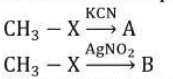
What will be the product for the following reactions?
From the following, choose the ones which are not secondary haloalkanes:
(A) 2-Bromopentane
(B) 1-Bromo-3-methylbutane
(C) 3-Bromopentane
(D) 2-Bromo-2-methylbutane
(E) 2-Bromo-3-methylbutane
Choose the correct answer from the options given below:


