
Which of the following is a velocity-time graph for uniform motion of a car?
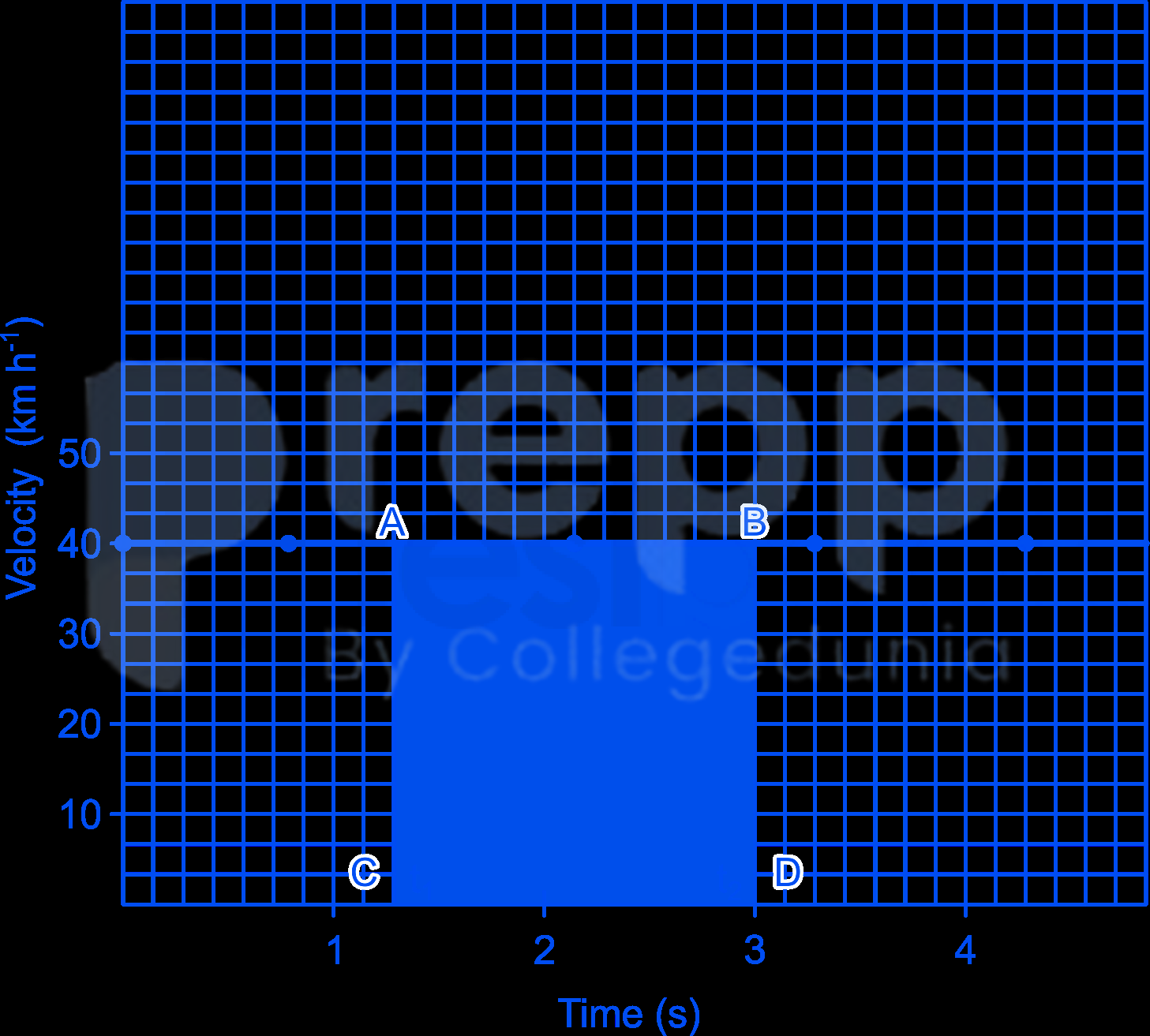
The Correct Answer is Option 1 i.e
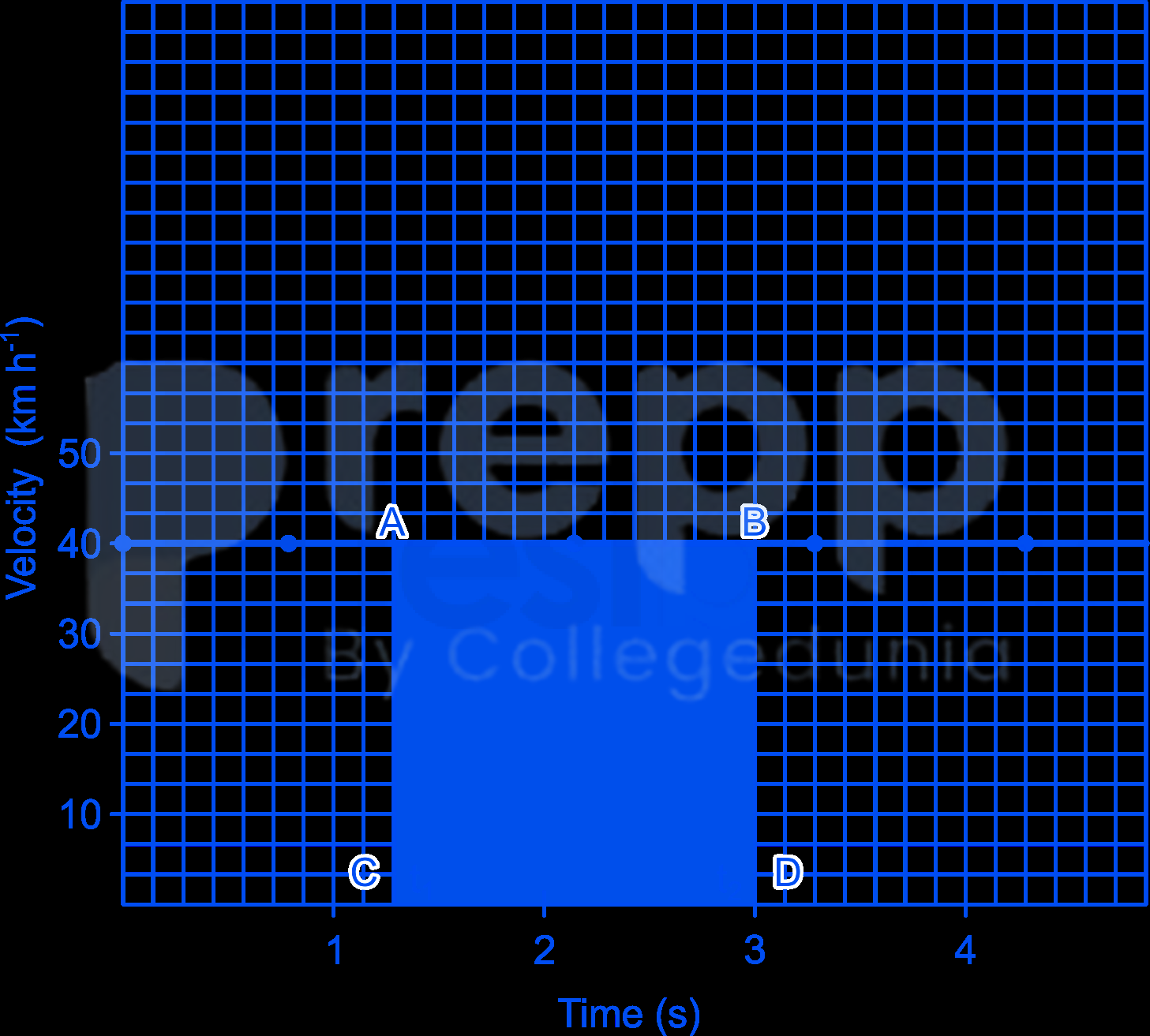
- The slope of a Velocity–time graph of an object moving with uniform velocity is astraight line and parallel to x-axiswhen velocity is taken along the y-axis and time is taken along the x-axis.
- It is the graph of velocity against time. It shows how the velocity changes with respect to time.
- The slope of a velocity-time graph determines its acceleration.
Calculation of distance using velocity-time graph:
Let two points A and B on the slope of the graph.
Draw two lines parallel to y-axis AC from point A, and BD from point B.(Above Fig.)
Let point D at the x-axis (time axis) is t2 and point C is t1.
Let AB meet at ‘v’ at the y-axis, i.e. object is moving with a velocity, v.
Thus, distance or displacement by the object is equal to the area of the rectangle (shaded) ABCD.
Thus, Area of ABCD = BD × DC
⇒ s = v(t2 - t1)
Since the given object is moving with constant velocity along a straight line, thus displacement will be equal to the distance covered.
Therefore, Distance or Displacement = velocity X time interval.
Similar Questions
Which of the following changes when a body performs uniform circular motion?
If the initial velocity of an object thrown upwards is 14 m/s, then the time taken for the object to reach its highest point will be_______. (a = 9.8 m/s2)
An object, starting from rest, moves with constant acceleration of 4 m/s 2. After 8 s, its speed is:
Why does a sprinter keep running even after crossing the finishing line?
The passengers standing in a bus fall in the backward direction when the stationary bus begins to move. Which of the following laws explains this situation?
Which of the following physical quantities changes or tends to change the state of rest or of uniform motion of a body in a straight line?
Work done by an object on the application of a force would be zero if the displacement of the object is:
A train, starting from rest, attains a velocity of 90 km/h in 5 minutes. Assuming that the acceleration is uniform, the distance travelled by the train during this time is:
The first equation of motion gives the relation between _________.
The rate of change of displacement is called:
Important Questions from Motion
An object is covering distance in direct proportion to the square of time elapsed. What conclusion can be drawn about the motion of the object?
If the distance time graph of the motion of an object is a straight line but not parallel to the time axis, then it may be concluded that the object is moving with a:
Which of the following changes when a body performs uniform circular motion?
Vehicles have treaded tires so that it_______.
If the initial velocity of an object thrown upwards is 14 m/s, then the time taken for the object to reach its highest point will be_______. (a = 9.8 m/s2)



