
Question
Which of the following graphs best represents the function given by the following equation : $f(x) = \frac{1}{\alpha} e^{- |\frac{x}{\alpha}|}$
The correct answer is
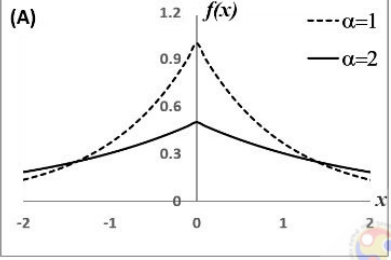
Analyzing the Function $f(x) = \frac{1}{\alpha} e^{- |\frac{x}{\alpha}|}$
To identify the correct graph, let's analyze the properties of the function $f(x) = \frac{1}{\alpha} e^{- |\frac{x}{\alpha}|}$, where $\alpha$ is typically a positive constant.
- Symmetry: The function involves $|\frac{x}{\alpha}|$. Since $|-x| = |x|$, we have $f(-x) = \frac{1}{\alpha} e^{- |\frac{-x}{\alpha}|} = \frac{1}{\alpha} e^{- |\frac{x}{\alpha}|} = f(x)$. This indicates the function is even and its graph is symmetric about the y-axis. Graphs 1 and 3 exhibit this symmetry.
- Value at $x=0$: $f(0) = \frac{1}{\alpha} e^{- |\frac{0}{\alpha}|} = \frac{1}{\alpha} e^0 = \frac{1}{\alpha}$. The graph must have a peak or pass through the point $(0, \frac{1}{\alpha})$.
- Behavior as $|x| \to \infty$: As $|x|$ increases, $|\frac{x}{\alpha}|$ increases, so $e^{- |\frac{x}{\alpha}|}$ approaches 0. Therefore, $f(x) \to 0$ as $|x| \to \infty$. The graph must approach the x-axis asymptotically.
- Derivative Analysis:
- For $x > 0$: $f(x) = \frac{1}{\alpha} e^{-\frac{x}{\alpha}}$. The derivative is $f'(x) = \frac{1}{\alpha} (-\frac{1}{\alpha}) e^{-\frac{x}{\alpha}} = -\frac{1}{\alpha^2} e^{-\frac{x}{\alpha}}$. This is negative, so the function decreases for $x > 0$.
- For $x < 0$: $f(x) = \frac{1}{\alpha} e^{\frac{x}{\alpha}}$. The derivative is $f'(x) = \frac{1}{\alpha} (\frac{1}{\alpha}) e^{\frac{x}{\alpha}} = \frac{1}{\alpha^2} e^{\frac{x}{\alpha}}$. This is positive, so the function increases for $x < 0$.
- At $x=0$: The derivative from the left ($x \to 0^-$) is $\frac{1}{\alpha^2}$, and the derivative from the right ($x \to 0^+$) is $-\frac{1}{\alpha^2}$. Since the left-hand and right-hand derivatives are not equal, the function has a sharp peak or cusp at $x=0$.
Comparing with Graph Options
Based on the analysis:
- The graph must be symmetric about the y-axis. This eliminates options 2 and 4.
- The graph must have a sharp peak (cusp) at $x=0$. Graph 1 shows a sharp peak at $x=0$, while Graph 3 shows a smooth peak.
- The function increases for $x<0$ and decreases for $x>0$, approaching 0 as $|x| \to \infty$. Graph 1 exhibits these characteristics.
Therefore, the graph that best represents the function $f(x) = \frac{1}{\alpha} e^{- |\frac{x}{\alpha}|}$ is the one with a sharp peak at the origin and symmetric exponential decay on both sides.
Conclusion: Option 1 matches these characteristics.
Was this answer helpful?
Important Questions from Functions Of Single Variable
- The gradient of $y = 3x^2 \sin(2x)$ at (0.2, 1) is __________ (rounded off to three decimal places).
- Let $ f(x) = x - [x] $, where $ x \ge 0 $ and $ [x] $ is the greatest integer not larger than x. Then $ f(x) $ is a
Consider the hyperbolic functions in Group – 1 and their definitions in Group - 2.
Group - 1 Group - 2 P $\tanh x$ I $\frac{e^x + e^{-x}}{e^x - e^{-x}}$ Q $\coth x$ II $\frac{2}{e^x + e^{-x}}$ R $\text{sech } x$ III $\frac{2}{e^x - e^{-x}}$ S $\text{cosech } x$ IV $\frac{e^x - e^{-x}}{e^x + e^{-x}}$ The correct combination is
- The equation of the straight line representing the tangent to the curve $y = x^2$ at the point $(1,1)$ is
- The figure which represents $y = \frac{\sin x}{x}$ for $x > 0$ (x in radians) is
Need Expert Advice?


