

Vertices Logic: Identifying The Figure That Doesn't Belong
This problem requires us to identify the figure that is different from the others based on its number of vertices. We need to carefully examine each shape presented.
Analyzing Each Figure Based on Vertices
We will look at each option, identify the shape, and count its vertices. A vertex is a corner point where edges meet.
| Option | Figure Type | Image Representation | Number of Vertices | Divisibility Check (by 2 or 3) |
|---|---|---|---|---|
| 1 | Pentagon | |
5 | No ($5 \pmod{2} \neq 0$ and $5 \pmod{3} \neq 0$) |
| 2 | Hexagon |  |
6 | Yes ($6 \pmod{2} = 0$ and $6 \pmod{3} = 0$) |
| 3 | Square |  |
4 | Yes ($4 \pmod{2} = 0$) |
| 4 | Triangle |  |
3 | Yes ($3 \pmod{3} = 0$) |
Identifying the Pattern Based on Vertex Count
Let's list the number of vertices for each shape:
- Option 1: 5 vertices
- Option 2: 6 vertices
- Option 3: 4 vertices
- Option 4: 3 vertices
We need to find a pattern or property that connects three of the figures, making the fourth one the outlier. Let's consider the divisibility of the number of vertices ($n$) by the numbers 2 and 3.
- For $n=3$ (Triangle): It is divisible by 3. ($3 \pmod{3} = 0$)
- For $n=4$ (Square): It is divisible by 2. ($4 \pmod{2} = 0$)
- For $n=5$ (Pentagon): It is not divisible by 2 and not divisible by 3. ($5 \pmod{2} \neq 0$, $5 \pmod{3} \neq 0$)
- For $n=6$ (Hexagon): It is divisible by 2 and divisible by 3. ($6 \pmod{2} = 0$, $6 \pmod{3} = 0$)
We can see that the number of vertices for the Triangle (3), Square (4), and Hexagon (6) are all divisible by 2 or 3.
Conclusion: The Figure That Doesn't Belong
The Pentagon (Option 1) has 5 vertices. Since 5 is not divisible by 2 or 3, it stands out from the other figures whose vertex counts (3, 4, and 6) are divisible by 2 or 3. Therefore, the Pentagon is the figure that doesn't belong based on this vertex divisibility pattern.
Similar Questions
Study the given pattern carefully and select the number that can replace the question mark (?) in it.
15 12 81 17 14 93 15 11 ? Figure A and B are related in a particular manner. Establish the same relationship between figures C and D by choosing the figure amongst these four options which would replace the question mark in figure D.
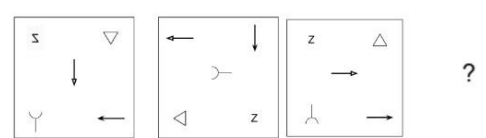
- Choose the CORRECT option.
Address 1: Mr. Rohit Sharma, 123/A, Rose Villa, Green Park, Delhi - 110016
Address 2: Mr. R. Sharma, 123-A, Rose Villa, Green Park, New Delhi - 110016
Are the two addresses likely to refer to the same person? - Address A: Mr. Riya Kapoor, 7/2, Lake View Road, Kolkata - 700029
Address B: Mr. R. Kapoor, 7/2A, Lake View Rd, Kolkata - 700029
What is the most significant difference between the two addresses? How many triangles are in the given figure?
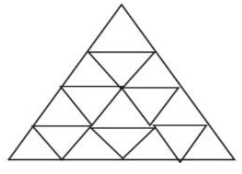
Which of the following numbers will replace the question mark (?) in the given series?
4, 11, 21, 37, 62, 109, 171, ?
If \(5 \bullet = \ 20\) and \(7 \bullet = \ 28\), then \(9 \bullet = \ ?\)
- Find the ODD one out.
Blue, Green, Red, Smooth Select from the alternatives, the box that can be formed by folding the sheet as shown in figure.
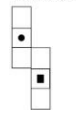
- Choose the figure which is different from the rest?
Important Questions from Miscellaneous
Which of the following is NOT a state function or state variable in a thermodynamic system?
- What is the full form for "BPL" in Socio-economic aspects?
- In October 2024, which of the following companies was awarded the contract for design, manufacturing and commissioning of two high-speed trainsets by Integral Coach Factory (ICF) to be used in India's first bullet train between Mumbai and Ahmedabad?
- Which of the following methods of reproduction simply involves the splitting of the parent cell into two daughter cells in the bacteria?
- A, B, C and D opened shopping complexes in the same city. The shopping complex of A is 6 km west of the shopping complex of B. The shopping complex of C is 4 km north of the shopping complex of B. The shopping complex of D is 6 km west of the shopping complex of C. In which direction is the shopping complex of D from the shopping complex of A?



