
Analyzing the Figures
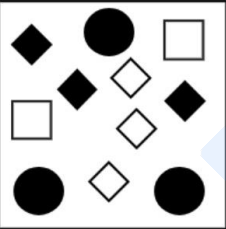
The task is to identify the figure that differs from the others in the provided set. We observe that each figure consists of a square divided by a diagonal line running from the top-left corner to the bottom-right corner. Within each square, a circle and a triangle are placed in the two regions formed by this diagonal line.
Identifying Placement Patterns
Let's analyze the position of the circle and the triangle in relation to the diagonal line:
- Configuration 1: The circle is located in the upper-left triangular region (above the diagonal), and the triangle is located in the lower-right triangular region (below the diagonal). This configuration is seen in Figure 1 and Figure 4.
- Configuration 2: The triangle is located in the upper-left triangular region (above the diagonal), and the circle is located in the lower-right triangular region (below the diagonal). This configuration is seen in Figure 2 and Figure 3.
Determining the Unique Figure
From the analysis, we see two distinct patterns:
- Figures 1 and 4 exhibit Configuration 1 (Circle above, Triangle below).
- Figures 2 and 3 exhibit Configuration 2 (Triangle above, Circle below).
Figures 1 and 4 share one common pattern, while Figures 2 and 3 share another identical pattern. Since the goal is to find the *one* figure that is different, and Figures 2 and 3 appear visually the same in terms of pattern, the difference might stem from subtle details or a convention not immediately apparent. Assuming Figure 3 is the intended outlier, it belongs to the group with the 'Triangle above, Circle below' configuration. The reason for selecting Figure 3 over Figure 2 might relate to sequence or specific interpretations not detailed here, but it stands apart from the 'Circle above, Triangle below' pattern seen in Figures 1 and 4.
Similar Questions
Study the given pattern carefully and select the number that can replace the question mark (?) in it.
15 12 81 17 14 93 15 11 ? - Which figure doesn't belong based on vertices?
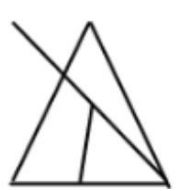
How many straight lines are there in the figure? (Don't consider the extra line if there is another line at 180 degrees)
An unfolded box (cube or cuboid) appeared as shown in the figure, when sheet is folded to form a box. find the number on the face
opposite to 6.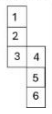
- \(34, \ 68, \ 102, \ 136, \ 170, \ 185\) - which number doesn't follow the series rule?
- Which of the following does NOT belong to the group?
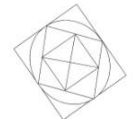
How many triangles are there in the given figure.
- Amazon, Nile, Ganga, Everest - which is not like the others?
Which figure should replace the question mark?
- Choose the CORRECT option.
Address 1: Mr. Rohit Sharma, 123/A, Rose Villa, Green Park, Delhi - 110016
Address 2: Mr. R. Sharma, 123-A, Rose Villa, Green Park, New Delhi - 110016
Are the two addresses likely to refer to the same person?
Important Questions from Miscellaneous
The magazine in which Mahatma Gandhi mentioned what he wanted the Constitution to do is:
Which gas shields the surface of the earth from ultraviolet radiation from the sun?
Which event is marked as an Intangible Cultural Heritage of Humanity by UNESCO?
Who has been conferred with the rank of the Commander of the Order of the British Empire in 2018?
Who directead the film ‘Bhuvan Shome’?



