
Magnetic Field Components Explained
The Earth's magnetic field ($B$) at any location can be represented by its horizontal ($B_H$) and vertical ($B_V$) components. These are related to the total field by the Pythagorean theorem: $B^2 = B_H^2 + B_V^2$
Applying Equal Components Condition
The problem states that at a particular place, the vertical component equals the horizontal component: $B_V = B_H$
Substitute this condition into the field equation: $B^2 = B_H^2 + B_H^2$ $B^2 = 2 B_H^2$ Solving for $B$, we get: $B = \sqrt{2 B_H^2} = B_H \sqrt{2}$
Equatorial Field Relation
At the Earth's equator, the magnetic field has a dip angle ($\delta$) of $0^\circ$. Therefore, the horizontal component ($B_{H_{eq}}$) is equal to the total field ($B_{eq}$): $B_{H_{eq}} = B_{eq} \cos(0^\circ) = B_{eq}$ Given $B_{eq} = 0.30 \text{ Oe}$, we find $B_{H_{eq}} = 0.30 \text{ Oe}$.
We assume the horizontal component $B_H$ at the location of interest is approximately the same as at the equator. Therefore, $B_H = 0.30 \text{ Oe}$.
Calculating Total Field Value
Using the relationship $B = B_H \sqrt{2}$ and the value $B_H = 0.30 \text{ Oe}$: $B = (0.30 \text{ Oe}) \times \sqrt{2}$
Calculate the numerical value using $\sqrt{2} \approx 1.4142$: $B \approx 0.30 \times 1.4142 \text{ Oe}$ $B \approx 0.42426 \text{ Oe}$
Rounding to two decimal places, the value of the Earth's magnetic field is $0.42 \text{ Oe}$.
Important Questions from Magnetic Methods
- The positions of the maximum and minimum anomaly values are observed at distance coordinates $35\text{ m}$ and $135\text{ m}$ respectively along a total field anomaly magnetic profile across a body resembling a single pole at the magnetic equator. Which of the following statements is true?
- If $(F_{max}, F_{min})$, $(V_{max}, V_{min})$ and $(H_{max}, H_{min})$ are the maximum and minimum values of the Earth's normal magnetic field on the Earth's surface, and its vertical and horizontal components respectively, then
- The total field magnetic anomaly at a location of magnetic latitude $30^\circ N$ due to an inhomogeneity is zero. Then the ratio of the anomalies in the vertical and horizontal components due to the same inhomogeneity would be
- What is the ratio of the Larmor precession frequencies measurable on the Earth's surface at the magnetic latitudes $30^\circ$ and $60^\circ$?
The following magnetic anomaly (in total field) is recorded along a south to north profile across a body that can be equated to a single pole.
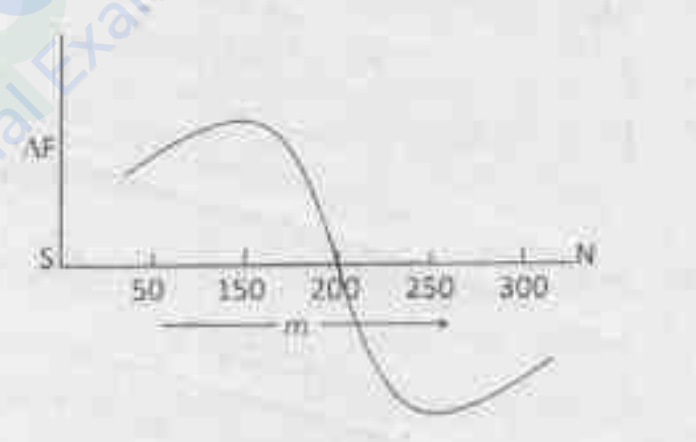
Consider the following statements
Statement I: The surveyed area is close to the magnetic equator
Statement II: The pole lies below the distance coordinate 200 m


