
Geophysical Anomaly Calculation
This solution determines the ratio between the vertical ($\Delta Z$) and horizontal ($\Delta H$) magnetic anomalies under specific conditions.
Magnetic Anomaly Component Relationship
The total field magnetic anomaly ($\Delta T$) is the projection of the anomaly vector onto the direction of the Earth's main magnetic field. At a given magnetic latitude ($\lambda$), the relationship between the vertical anomaly ($\Delta Z$), the horizontal anomaly ($\Delta H$), and the inclination ($I$) is given by:
$ \Delta T = \Delta Z \sin I + \Delta H \cos I $
We are given that the total field anomaly is zero ($\Delta T = 0$):
$ \Delta Z \sin I + \Delta H \cos I = 0 $
The inclination ($I$) is related to the magnetic latitude ($\lambda$) by:
$ \tan I = 2 \tan \lambda $
Calculating the Ratio
First, we rearrange the $\Delta T = 0$ equation to find the ratio $\Delta Z / \Delta H$:
$ \frac{\Delta Z}{\Delta H} = -\frac{\cos I}{\sin I} = -\cot I $
Next, we calculate the inclination ($I$) using the given magnetic latitude $\lambda = 30^\circ N$:
$ \tan I = 2 \tan(30^\circ) = 2 \times \frac{1}{\sqrt{3}} = \frac{2}{\sqrt{3}} $
Now, we find the cotangent of the inclination:
$ \cot I = \frac{1}{\tan I} = \frac{1}{2/\sqrt{3}} = \frac{\sqrt{3}}{2} $
Finally, substitute the value of $\cot I$ back into the ratio equation:
$ \frac{\Delta Z}{\Delta H} = -\cot I = -\frac{\sqrt{3}}{2} $
Therefore, the ratio of the anomalies in the vertical and horizontal components ($\Delta Z : \Delta H$) is:
$ -\sqrt{3} : 2 $
Important Questions from Magnetic Methods
- What is the value of the Earth’s magnetic field (in Oe) at a place where its vertical and horizontal components are equal if the magnetic field at the equator is $0.30\text{ Oe}$?
- The positions of the maximum and minimum anomaly values are observed at distance coordinates $35\text{ m}$ and $135\text{ m}$ respectively along a total field anomaly magnetic profile across a body resembling a single pole at the magnetic equator. Which of the following statements is true?
- If $(F_{max}, F_{min})$, $(V_{max}, V_{min})$ and $(H_{max}, H_{min})$ are the maximum and minimum values of the Earth's normal magnetic field on the Earth's surface, and its vertical and horizontal components respectively, then
- What is the ratio of the Larmor precession frequencies measurable on the Earth's surface at the magnetic latitudes $30^\circ$ and $60^\circ$?
The following magnetic anomaly (in total field) is recorded along a south to north profile across a body that can be equated to a single pole.
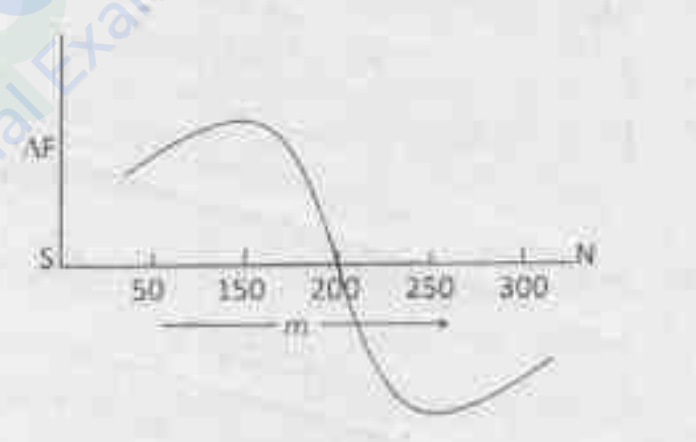
Consider the following statements
Statement I: The surveyed area is close to the magnetic equator
Statement II: The pole lies below the distance coordinate 200 m


