
Calculating Larmor Frequency Ratio at Magnetic Latitudes
The Larmor precession frequency ($\omega$) is directly proportional to the magnetic field strength ($B$). For Earth's magnetic field, approximated as a dipole, the field strength at a magnetic latitude ($\lambda$) is given by the formula:
$B(\lambda) = B_0 \sqrt{1 + 3 \sin^2\lambda}$
where $B_0$ is the magnetic field strength at the magnetic equator ($\lambda=0^\circ$).
Magnetic Field Strength Calculation
We need to find the ratio of the Larmor frequencies at magnetic latitudes $\lambda_1 = 30^\circ$ and $\lambda_2 = 60^\circ$. This ratio is equivalent to the ratio of the magnetic field strengths at these latitudes.
- For $\lambda_1 = 30^\circ$:
- $\sin(30^\circ) = \frac{1}{2}$
- $\sin^2(30^\circ) = \left(\frac{1}{2}\right)^2 = \frac{1}{4}$
- $B(30^\circ) = B_0 \sqrt{1 + 3 \left(\frac{1}{4}\right)} = B_0 \sqrt{1 + \frac{3}{4}} = B_0 \sqrt{\frac{7}{4}}$
- For $\lambda_2 = 60^\circ$:
- $\sin(60^\circ) = \frac{\sqrt{3}}{2}$
- $\sin^2(60^\circ) = \left(\frac{\sqrt{3}}{2}\right)^2 = \frac{3}{4}$
- $B(60^\circ) = B_0 \sqrt{1 + 3 \left(\frac{3}{4}\right)} = B_0 \sqrt{1 + \frac{9}{4}} = B_0 \sqrt{\frac{13}{4}}$
Ratio of Larmor Frequencies
The ratio of the Larmor precession frequencies is the ratio of the magnetic field strengths:
$\frac{\omega_1}{\omega_2} = \frac{B(30^\circ)}{B(60^\circ)} = \frac{B_0 \sqrt{\frac{7}{4}}}{B_0 \sqrt{\frac{13}{4}}}$
Simplifying the expression:
$\frac{\omega_1}{\omega_2} = \frac{\sqrt{\frac{7}{4}}}{\sqrt{\frac{13}{4}}} = \sqrt{\frac{7/4}{13/4}} = \sqrt{\frac{7}{13}}$
Therefore, the ratio is $\sqrt{7} : \sqrt{13}$.
Important Questions from Magnetic Methods
- What is the value of the Earth’s magnetic field (in Oe) at a place where its vertical and horizontal components are equal if the magnetic field at the equator is $0.30\text{ Oe}$?
- The positions of the maximum and minimum anomaly values are observed at distance coordinates $35\text{ m}$ and $135\text{ m}$ respectively along a total field anomaly magnetic profile across a body resembling a single pole at the magnetic equator. Which of the following statements is true?
- If $(F_{max}, F_{min})$, $(V_{max}, V_{min})$ and $(H_{max}, H_{min})$ are the maximum and minimum values of the Earth's normal magnetic field on the Earth's surface, and its vertical and horizontal components respectively, then
- The total field magnetic anomaly at a location of magnetic latitude $30^\circ N$ due to an inhomogeneity is zero. Then the ratio of the anomalies in the vertical and horizontal components due to the same inhomogeneity would be
The following magnetic anomaly (in total field) is recorded along a south to north profile across a body that can be equated to a single pole.
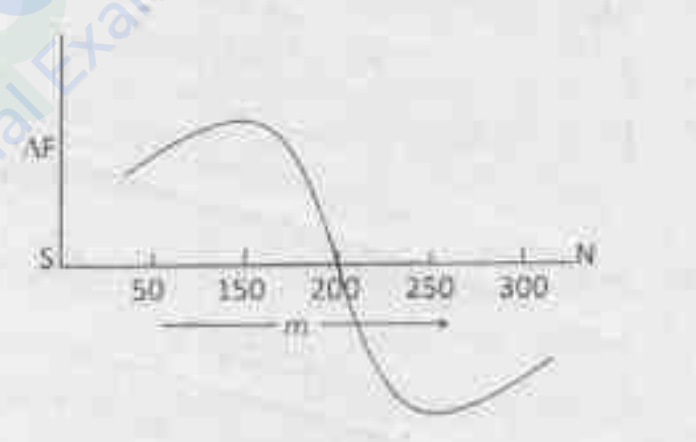
Consider the following statements
Statement I: The surveyed area is close to the magnetic equator
Statement II: The pole lies below the distance coordinate 200 m


