
The Earth's magnetic field ($F$) at any point can be represented as the vector sum of its horizontal component ($H$) and vertical component ($V$). This relationship follows the Pythagorean theorem:
$F^2 = H^2 + V^2$
Magnetic Field Component Relationship
The question provides the maximum and minimum values for the total field ($F_{max}, F_{min}$), vertical component ($V_{max}, V_{min}$), and horizontal component ($H_{max}, H_{min}$). We need to find the correct relationship between these extreme values.
Analyzing Maximum Total Field
The maximum value of the Earth's total magnetic field ($F_{max}$) typically occurs at high latitudes, near the magnetic poles. At these locations:
- The vertical component ($V$) is dominant and approaches its maximum possible value ($V_{max}$).
- The horizontal component ($H$) is minimal, approaching its minimum possible value ($H_{min}$), which is close to zero.
Considering the fundamental relationship $F^2 = H^2 + V^2$, when $F$ is at its maximum ($F_{max}$), the corresponding components $H$ and $V$ are generally the ones prevalent at that location.
Therefore, the maximum total field ($F_{max}$) relates to the maximum vertical component ($V_{max}$) and the minimum horizontal component ($H_{min}$) as follows:
$F_{max}^2 = V_{max}^2 + H_{min}^2$
This equation holds because the location yielding the absolute maximum total field strength often corresponds to the location where the vertical component is strongest and the horizontal component is weakest.
Conclusion
Based on the physical behavior of the Earth's magnetic field components, the correct relationship is $F_{max}^2 = V_{max}^2 + H_{min}^2$. This corresponds to Option B.
Important Questions from Magnetic Methods
- What is the value of the Earth’s magnetic field (in Oe) at a place where its vertical and horizontal components are equal if the magnetic field at the equator is $0.30\text{ Oe}$?
- The positions of the maximum and minimum anomaly values are observed at distance coordinates $35\text{ m}$ and $135\text{ m}$ respectively along a total field anomaly magnetic profile across a body resembling a single pole at the magnetic equator. Which of the following statements is true?
- The total field magnetic anomaly at a location of magnetic latitude $30^\circ N$ due to an inhomogeneity is zero. Then the ratio of the anomalies in the vertical and horizontal components due to the same inhomogeneity would be
- What is the ratio of the Larmor precession frequencies measurable on the Earth's surface at the magnetic latitudes $30^\circ$ and $60^\circ$?
The following magnetic anomaly (in total field) is recorded along a south to north profile across a body that can be equated to a single pole.
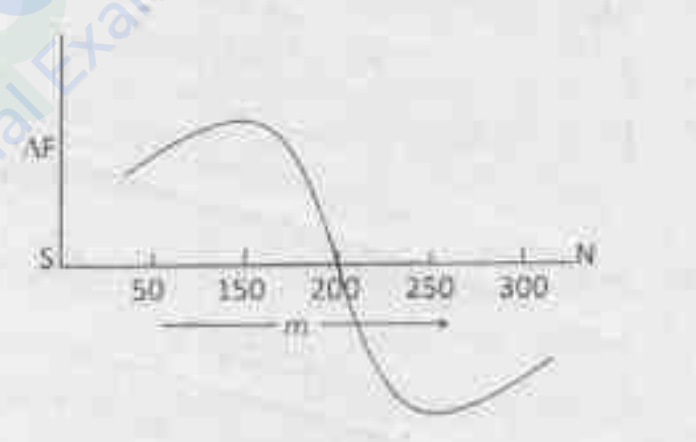
Consider the following statements
Statement I: The surveyed area is close to the magnetic equator
Statement II: The pole lies below the distance coordinate 200 m


