
Circles Intersection Basics
When considering the intersection of circles, two distinct circles can intersect each other at a maximum of 2 points. This is the key principle for finding the overall maximum intersections.
Calculating Maximum Points for 5 Circles
To find the maximum number of intersection points for 5 circles, we need to determine how many unique pairs of circles can be formed. Each pair can contribute a maximum of 2 intersection points.
We can use the combinations formula to find the number of ways to choose 2 circles from a set of 5. The formula is:
\(C(n, k) = \binom{n}{k} = \frac{n!}{k!(n-k)!}\)
In this case, \(n=5\) (total number of circles) and \(k=2\) (number of circles in each pair).
Number of pairs = \(C(5, 2) = \binom{5}{2} = \frac{5!}{2!(5-2)!} = \frac{5!}{2!3!} = \frac{5 \times 4}{2 \times 1} = 10\).
So, there are 10 unique pairs of circles.
Since each of these 10 pairs can intersect at a maximum of 2 points, the total maximum number of intersection points is:
Total Points = (Number of Pairs) \(\times\) 2 = \(10 \times 2 = 20\).
Therefore, the maximum number of points of intersection for 5 circles is 20.
Similar Questions
- Three perfect dice \(D_1, D_2\) and \(D_3\) are rolled. Let \(x, y\) and \(z\) represent the numbers on \(D_1, D_2\) and \(D_3\) respectively. What is the number of possible outcomes such that \(x < y < z\)?
- A man has \(7\) relatives (\(4\) women and \(3\) men). His wife also has \(7\) relatives (\(3\) women and \(4\) men). In how many ways can they invite \(3\) women and \(3\) men so that \(3\) of them are man's relatives and \(3\) of them are his wife's relatives?
- A triangle \(PQR\) is such that \(3\) points lie on the side \(PQ\), \(4\) points on \(QR\) and \(5\) points on \(RP\) respectively. Triangles are constructed using these points as vertices. What is the number of triangles so formed ?
- How many four-digit natural numbers are there such that all of the digits are even?
- How many 4-digit numbers are there having all digits as odd?
- In how many ways can the letters of the word INDIA be permutated such that in each combination, vowels should occupy odd positions?
- The letters of the word EQUATION are arranged in such a way that all vowels as well as consonants are together. How many such arrangements are there?
- What is the maximum number of possible points of intersection of four straight lines and a circle (intersection is between lines as well as circle and lines)?
- What is the sum of all four digit numbers formed by using all digits \(0, 1, 4, 5\) without repetition of digits?
- In how many ways can a student choose \((n-2)\) courses out of \(n\) courses if 2 courses are compulsory \((n > 4)\)?
Important Questions from Permutation and Combination
The following figure is made with nine squares of length 1 cm each.
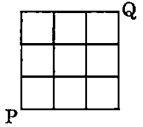
A student is standing at point P. The total number of shortest paths to reach point Q from point P, if the student walks along the boundaries of the squares only, is:
Consider the following statements (all the angles are measured in degrees) :
1. If two supplementary angles are $4x + 40$ and $10x$, then $x$ is;
2. The complementary angle of $\frac{4}{5} \times 45$ is :
3. If two complementary angles are in the ratio of $4 : 5$, then the smallest angle is :
Which of the following is correct?
Codes:
1 2 3- There are 40 persons in a palace. If every person shakes hands with every other person, what will be the total number of handshakes?
- How many words can be formed with or without meaning by using all letters of the word DELHI?
A rectangular wall is divided into four squares of equal size where there are two rows each having two squares. The top left square is coloured with green. If, including green, there are three colours available and each square is coloured using any one of these three colours such that no two adjacent squares get painted with the same colour; then how many colour combinations are possible ?



