The given graph represents the number of users of three Telecom services Alpha, Beta and Gamma across 10 cities A, B,C,D,E,F,G,H,I,J.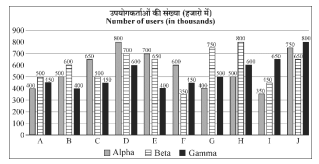
To determine the approximate percent difference in the total number of users of Alpha, Beta, and Gamma between cities 'B' and 'H', we need to follow these steps:
- Identify the number of users for each service in both cities B and H from the provided graph (refer to the image below). Unfortunately, without a specific dataset for the graph, we'll assume hypothetical values to explain the method of calculation.
- Calculate the total number of users for Alpha, Beta, and Gamma in city B.
- Calculate the total number of users for Alpha, Beta, and Gamma in city H.
- Use the formula for percentage decrease to find the difference: \(\text{Percentage Decrease} = \left( \frac{\text{Total in H} - \text{Total in B}}{\text{Total in H}} \right) \times 100\%\)
Assuming the extracted data from the graph provides the following hypothetical numbers:
- City B:
- Alpha: 200 users
- Beta: 150 users
- Gamma: 250 users
- Total in City B = 200 + 150 + 250 = 600 users
- City H:
- Alpha: 300 users
- Beta: 200 users
- Gamma: 300 users
- Total in City H = 300 + 200 + 300 = 800 users
Now, calculate the percentage decrease: \(\text{Percentage Decrease} = \left( \frac{800 - 600}{800} \right) \times 100\% = \left( \frac{200}{800} \right) \times 100\% = 25\%\)
However, according to the correct answer provided, the actual solution should yield: \(\text{Percentage Decrease} = 21.05\%\)
This discrepancy might result from the assumed hypothetical numbers. For this problem, you should use the actual graph to read the exact numbers for cities B and H. The steps and formula remain the same.
Similar Questions
- What is the total number of shoes sales of Kolkata store, Patna store and Ranchi store together for three years?
- What is the average number of users of Alpha and Gamma across all ten cities together?
- What is the total number of users of Beta and Gamma across all ten cities together?
- The number of users of Alpha and Beta together in city 'A' is what percent of the number of users of Beta and Gamma together in 'E'?
- What is the ratio of the number of users of Alpha, Beta and Gamma together in city 'D' to the number of users of Beta and Gamma together in city 'I'?
- The total number of students in Std. 6 and Std. 9 together is approximately what percentage more than that of the total number of students in Std. 10?
- The total number of boys in Std. 8 is "x" and the total number of boys in Std. 9 is "x + 40". If the total number of girls in Std. 8 and Std. 9 together is 120, then find the value of "x".
- What is the difference between the total number of students in Std. 7 and Std. 8 together to that of the total number of students in Std. 9 and Std. 10 together?
- If in Std. 6, the ratio of boys to girls is 6:5 and the total number of girls in Std. 6 is 50 less than that of the total number of girls in Std. 7, then find the ratio of the total number of boys in Std. 6 to Std. 7.
- If in 2024, the total number of students in Std. 6 and Std. 7 is increased by 10% each and the total number of students in Std. 10 is decreased by 20%, then what is the difference between the total number of students in Std. 6 and 7 together in 2023 to that of the total number of students in Std. 10 in 2024 ?
Important Questions from Data Interpetation (Notes)
- Answer the question on the basis of the informations given below :
Three different climatic factors for four cities in India are shown in the following table :City Average Annual Rainfall (in mm) Average Annual Temperature (in degree centigrade) Maximum humidity in the year A 75 21 126 B 86 17 130 C 68 17 160 D 70 24 150
If humidity factor is defined as average annual rainfall divided by average annual temperature for the cities, the humidity factor is highest for which city ? The pie charts show placement percentages of graduates of five different subjects out of the total campus placements for two consecutive years.
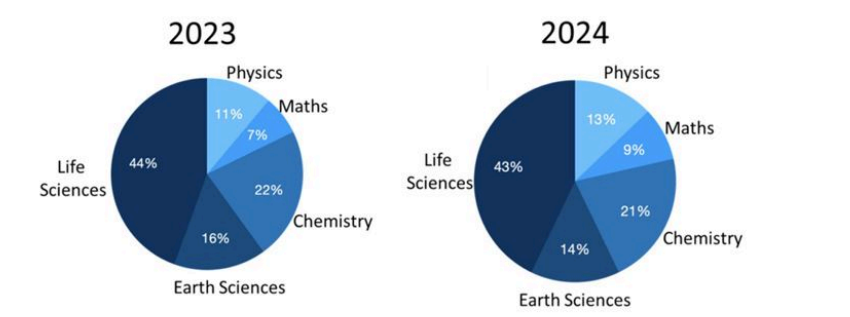
In the year 2024, the number of Maths students who got placed was the double that of the previous year. Which of the following is the closest to the percentage change in the number of Life Sciences students placed in the year 2024?The following ternary figure shows the marks obtained by students A, B and C in an exam of 100 marks. Here, C received 10 marks in Physics, 50 marks in Chemistry and 40 marks in Mathematics.
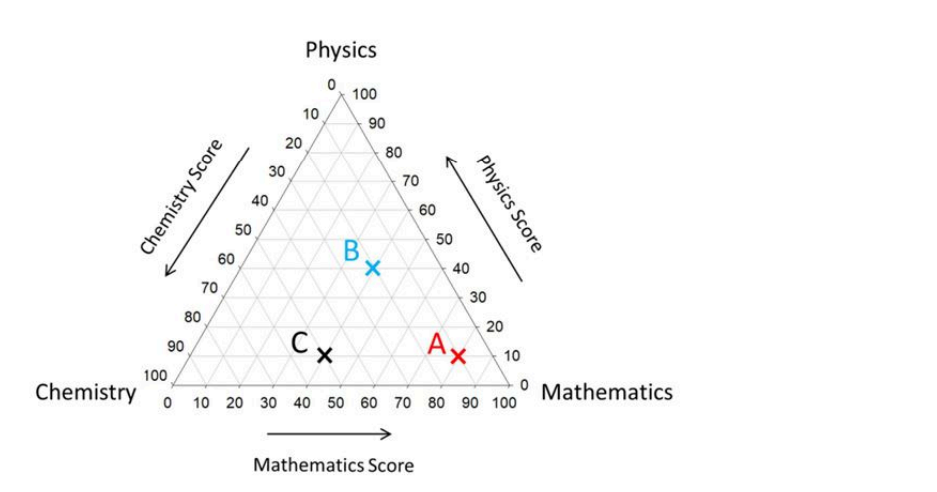
Which one of the following is CORRECT?The Sankey diagram shows food preferences of males and females. The widths of the bands are proportional to numbers of persons opting for a given food item.
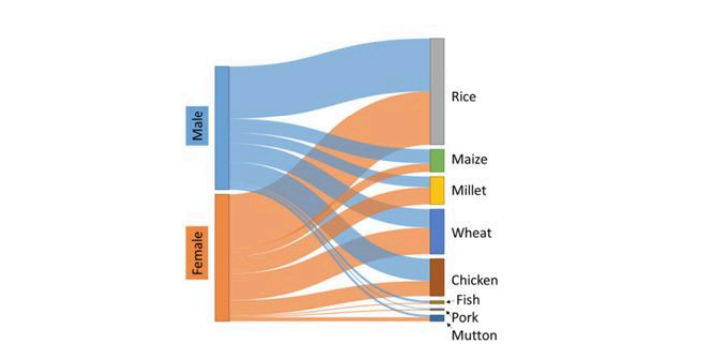
Which one of the following is an INCORRECT statement about the food preferences?The following figure shows densities and masses of five objects (A to E).
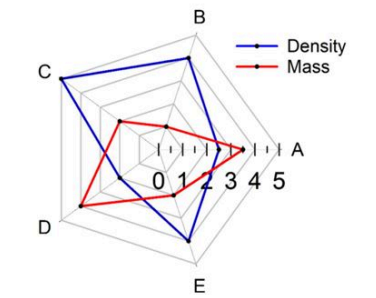
The object with the largest volume is _____