
Granite Weathering Explained
The weathering of granite involves chemical and physical processes that break down its constituent minerals. Granite is mainly composed of quartz, feldspars (like potassium feldspar and plagioclase), and micas.
Mineral Breakdown and Element Release
- Quartz: Highly resistant to chemical weathering, it mostly remains as solid silicon dioxide (SiO2).
- Feldspars: These minerals, particularly alkali feldspars (containing Na and K), undergo hydrolysis. This reaction breaks them down into secondary clay minerals (aluminosilicates) and releases soluble ions like sodium (Na+) and potassium (K+) into the surrounding water.
- Micas: Also weather to form clays, releasing cations like K+ and Mg2+, and forming hydrated aluminosilicates.
- Iron (Fe) and Manganese (Mn): These elements are typically present in smaller amounts or within specific accessory minerals in granite. While they can be released during weathering, often as ions (Fe2+, Fe3+, Mn2+), they are frequently incorporated into secondary minerals or precipitate as oxides/hydroxides, making their release as simple dissolved ions less dominant compared to alkali metals.
Released Elements Focus
The question asks specifically for elements released as dissolved ions. During the weathering of common granite minerals like feldspars, alkali metals such as sodium and potassium are readily liberated as mobile, dissolved ions (Na+, K+). While silicon (Si) and aluminum (Al) are components of the original minerals and form secondary minerals, their release as simple dissolved ions is less characteristic than the release of Na and K.
Conclusion on Released Elements
Therefore, the primary elements released as dissolved ions from the weathering of granite's feldspar components are Na and K.
Important Questions from Weathering
- Bauxite formation is an example of metal enrichment by extreme
- Silcretes or silica-rich duricrusts generally form under
During normal weathering of a granite rock (A), clay minerals and then residue of gibbsite are formed. Which one is the correct weathering path for the rock in the given diagram ($\text{Al}_2\text{O}_3$, $\text{CaO}$, $\text{Na}_2\text{O}$ and $\text{K}_2\text{O}$ are in moles).
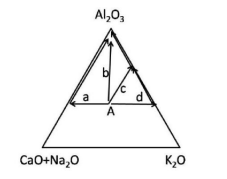
- During spheroidal weathering, a block of rock converts to a spheroid due to
- Which type(s) of chemical reactions occur(s) during the weathering of pyroxene?


