
Poisson Distribution Probability: Ace of Spades
This question asks for the probability of a specific event occurring at least once within a series of trials, using the Poisson distribution. The event is drawing the 'ace of spades' from a standard, well-shuffled deck of cards over 104 consecutive trials.
Understanding the Problem Parameters
We need to find the probability of drawing the ace of spades at least once in 104 trials. The Poisson distribution is often used as an approximation for the binomial distribution when the number of trials ($n$) is large and the probability of success ($p$) in a single trial is small. Here:
- Number of trials, $n = 104$.
- The probability of drawing the ace of spades in a single trial (success) is $p$. Since there's only one ace of spades in a standard 52-card deck, $p = \frac{1}{52}$.
Applying the Poisson Distribution
The Poisson distribution models the number of events occurring within a fixed interval. The parameter $\lambda$ (lambda) represents the average rate of events, calculated as the product of the number of trials and the probability of success per trial:
$ \lambda = n \times p $
Substituting the values:
$ \lambda = 104 \times \frac{1}{52} = 2 $
So, the average number of times the ace of spades is expected to be drawn in 104 trials is 2.
Calculating the Probability
The probability mass function (PMF) for a Poisson distribution is given by:
$ P(X=k) = \frac{e^{-\lambda}\lambda^k}{k!} $
Where:
- $P(X=k)$ is the probability of the event occurring exactly $k$ times.
- $e$ is the base of the natural logarithm (approximately 2.71828).
- $\lambda$ is the average rate (calculated as 2).
- $k$ is the number of occurrences.
We want the probability of the ace of spades appearing *at least once*, which means $k \ge 1$. It's easier to calculate the complement probability: the probability that the ace of spades is *never* drawn ($k=0$), and subtract this from 1.
$ P(X \ge 1) = 1 - P(X=0) $
Let's calculate $P(X=0)$ using the Poisson PMF with $\lambda=2$ and $k=0$:
$ P(X=0) = \frac{e^{-2} \times 2^0}{0!} $
Recall that $2^0 = 1$ and $0! = 1$. Therefore:
$ P(X=0) = \frac{e^{-2} \times 1}{1} = e^{-2} $
Final Calculation
Now, we calculate the value of $e^{-2}$:
$ e^{-2} \approx 0.1353 $
Finally, we find the probability of drawing the ace of spades at least once:
$ P(X \ge 1) = 1 - P(X=0) = 1 - e^{-2} $
$ P(X \ge 1) \approx 1 - 0.1353 = 0.8647 $
Rounding to three decimal places, the probability is approximately 0.865.
Conclusion
The probability that the ace of spades will be drawn from the pack of well-shuffled cards at least once in 104 consecutive trials, using the Poisson distribution approximation, is approximately 0.865.
Important Questions from Probability (Notes)
- A stick of length L is broken into two pieces at random. What is the average length of the smaller piece?
- Two students are solving the same problem independently. If the probability that the first one solves the problem is $\frac{3}{5}$ and the probability that the second solves the problem is $\frac{4}{5}$, what is the probability that at least one of them solves the problem?
- A fair die was thrown three times and the outcome was repeatedly six. If the die is thrown again what is the probability of getting six?
- 12 balls, 3 each of the colours red, green, blue and yellow are put in a box and mixed. If 3 balls are picked at random, without replacement, the probability that all 3 balls are of the same colour is
A canal system is shown in the figure.
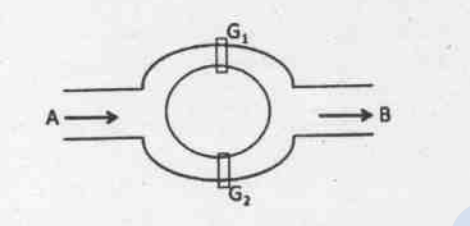
Water flows from A to B through two channels. Gates $G_1$ and $G_2$ are operated independently to regulate the flow. Probability of $G_1$ to be open is 10% while that of $G_2$ is 20%. The probability that water will flow from A to B is


