
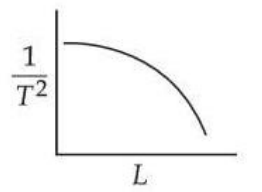
Simple Pendulum: Time Period vs Length Relation
The time period (T) of a simple pendulum is determined by its length (L) and the acceleration due to gravity (g). The standard formula relating these quantities is:
$T = 2\pi \sqrt{\frac{L}{g}}$
From this formula, we can establish the relationship between T and L. Squaring both sides yields:
$T^2 = \frac{4\pi^2}{g} L$
This equation shows that $T^2$ is directly proportional to L ($T^2 \propto L$). Consequently, the time period T is proportional to the square root of the length L:
$T \propto \sqrt{L}$
This proportionality implies the following characteristics for a plot of T (y-axis) versus L (x-axis):
- The graph starts at the origin (0,0), as a pendulum of zero length has zero period.
- As L increases, T increases.
- The rate of increase of T slows down as L gets larger, meaning the curve bends downwards (it is concave down). This reflects the square root relationship.
Comparing this with the given options:
- Option 1 shows a curve starting from the origin where T increases with L, exhibiting the characteristic downward bend. This matches the $T \propto \sqrt{L}$ relationship.
- Option 2 represents a linear relationship ($T \propto L$).
- Option 3 represents a linear relationship that does not pass through the origin.
- Option 4 shows T decreasing as L increases.
Therefore, the plot that correctly represents the relation between the pendulum length L and time period T is the curve shown in Option 1.
Similar Questions
- The displacement of a particle, executing simple harmonic motion with time period $T$, is expressed as $x(t) = A\sin\omega t$, where $A$ is the amplitude. The maximum value of potential energy of this oscillator is found at $t = T/2\beta$. The value of $\beta$ is ________.
A simple pendulum has a bob with mass $m$ and charge $q$. The pendulum string has negligible mass. When a uniform and horizontal electric field $\vec{E}$ is applied, the tension in the string changes. The final tension in the string, when pendulum attains an equilibrium position is _________.
(g: acceleration due to gravity)In an open organ pipe $\nu_3$ and $\nu_6$ are $3^{\text{rd}}$ and $6^{\text{th}}$ harmonic frequencies, respectively. If $\nu_6 - \nu_3 = 2200 \text{ Hz}$ then length of the pipe is _________ mm.
(Take velocity of sound in air is $330 \text{ m/s}$.)- A cylindrical block of mass $M$ and area of cross section $A$ is floating in a liquid of density $\rho$ and with its axis vertical. When depressed a little and released the block starts oscillating. The period of oscillation is ______.
- The kinetic energy of a simple harmonic oscillator is oscillating with angular frequency of $176\text{ rad/s}$. The frequency of this simple harmonic oscillator is __________ $\text{Hz}$. $\left[ \text{take } \pi = \frac{22}{7} \right]$
- Two tuning forks $A$ and $B$ are sounded together giving rise to $8$ beats in $2\text{ s}$. When fork $A$ is loaded with wax, the beat frequency is reduced to $4$ beats in $2\text{ s}$. If the original frequency of tuning fork $B$ is $380\text{ Hz}$ then original frequency of tuning fork $A$ is _________ $\text{Hz}$.
- A simple pendulum of string length 30 cm performs 20 oscillations in 10 s. The length of the string required for the pendulum to perform 40 oscillations in the same time duration is ___________ cm. [Assume that the mass of the pendulum remains same.]
- The velocity of sound in air is doubled when the temperature is raised from $0^\circ\text{C}$ to $\alpha^\circ\text{C}$. The value of $\alpha$ is ________.
- A particle is executing simple harmonic motion. Its amplitude is $A$ and time period is 5 sec. The time required by it to move from $x = A$ to $x = \frac{A}{\sqrt{2}}$ is _________ sec.
- Match List - I with List - II.
List - I List - II A. $\sin^{2} \omega t$ I. Periodic with time period $T=\frac{\pi}{\omega}$ but not simple harmonic motion (SHM) B. $\sin^{3} (2\omega t)$ II. Periodic with time period $T=\frac{2\pi}{\omega}$ but Not SHM C. $\sin (\omega t) + \cos(\pi \omega t)$ III. Periodic with time period $T=\frac{\pi}{\omega}$ and SHM D. $\cos \omega t + \cos 2\omega t$ IV. Non-periodic
Choose the correct answer from the options given below :
Important Questions from Oscillations and Waves
- The displacement of a particle, executing simple harmonic motion with time period $T$, is expressed as $x(t) = A\sin\omega t$, where $A$ is the amplitude. The maximum value of potential energy of this oscillator is found at $t = T/2\beta$. The value of $\beta$ is ________.
A simple pendulum has a bob with mass $m$ and charge $q$. The pendulum string has negligible mass. When a uniform and horizontal electric field $\vec{E}$ is applied, the tension in the string changes. The final tension in the string, when pendulum attains an equilibrium position is _________.
(g: acceleration due to gravity)In an open organ pipe $\nu_3$ and $\nu_6$ are $3^{\text{rd}}$ and $6^{\text{th}}$ harmonic frequencies, respectively. If $\nu_6 - \nu_3 = 2200 \text{ Hz}$ then length of the pipe is _________ mm.
(Take velocity of sound in air is $330 \text{ m/s}$.)- A cylindrical block of mass $M$ and area of cross section $A$ is floating in a liquid of density $\rho$ and with its axis vertical. When depressed a little and released the block starts oscillating. The period of oscillation is ______.
- The kinetic energy of a simple harmonic oscillator is oscillating with angular frequency of $176\text{ rad/s}$. The frequency of this simple harmonic oscillator is __________ $\text{Hz}$. $\left[ \text{take } \pi = \frac{22}{7} \right]$


