
View Factor Definition
The view factor ($F_{12}$) quantifies the fraction of radiation leaving surface 1 that is intercepted by surface 2. It depends solely on the geometry between the surfaces.
View Factor for Large Parallel Walls
For very large parallel walls facing each other (approximating infinite parallel plates), the geometry dictates that all radiation leaving one wall strikes the other. Therefore, the view factor is:
$ F_{12} = 1 $
Analysis of the Given Answer Range
The problem provides an answer range of 0.4 to 0.42. This value does not align with the geometric definition of the view factor ($F_{12}=1$) for the described scenario. The provided emissivities ($\epsilon_1 = 0.5$, $\epsilon_2 = 0.7$) are typically used for calculating radiation heat transfer, not the view factor itself.
Calculation Yielding the Answer Range
A calculation using the given emissivities for parallel gray surfaces yields a result within the specified range. This calculation represents the effective emissivity ($\epsilon_{eff}$) of the space between the walls, a concept used in radiation network analysis:
$ \epsilon_{eff} = \frac{1}{\frac{1}{\epsilon_1} + \frac{1}{\epsilon_2} - 1} $
Substituting the given values:
- $ \epsilon_{eff} = \frac{1}{\frac{1}{0.5} + \frac{1}{0.7} - 1} $
- $ \epsilon_{eff} = \frac{1}{2 + 1.42857... - 1} $
- $ \epsilon_{eff} = \frac{1}{2.42857...} \approx 0.4118 $
This result ($\approx 0.4118$) falls within the 0.4 to 0.42 range, suggesting the question might implicitly refer to this calculation related to thermal radiation exchange rather than the strict geometric view factor.
Important Questions from Radiation
- A body is placed inside a perfectly black enclosure and is allowed to reach thermal equilibrium. According to the Kirchhoff’s identity, which one of the following is equal to the emissivity of the body at a given wavelength?
Thermal radiation takes place at a surface which has reflectivity of 0.55 and a transmissivity of 0.032. What is the value of absorptivity?
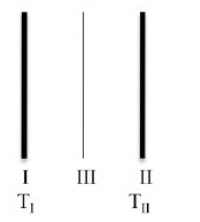
Two infinitely large parallel plates (I and II) are held at temperatures $T_I$ and $T_{II}$ ($T_I > T_{II}$) respectively, and placed at a distance $2d$ apart in vacuum. An infinitely large flat radiation shield (III) is placed in parallel in between I and II. The emissivities of all the plates are equal. The ratio of the steady state radiative heat fluxes with and without the shield is:
- The space between two hollow concentric spheres of radii 0.1 m and 0.2 m is under vacuum.
Exchange of radiation (uniform in all directions) occurs only between the outer surface ($S_1$) of the smaller sphere and the inner surface ($S_2$) of the larger sphere. The fraction (rounded off to the second decimal place) of the radiation energy leaving $S_2$, which reaches $S_1$ is - Given that $E$ (in $W.m^{-2}$) is the total hemispherical emissive power of a surface maintained at a certain temperature, which of the following statements is/are CORRECT?


