
Understanding Total Hemispherical Emissive Power
Total Hemispherical Emissive Power ($E$), measured in $W.m^{-2}$, represents the total energy radiated by a surface per unit area, considering all directions within a hemisphere and integrating over all wavelengths.
Analysis of Statements
- Statement 1: $E$ does not depend on the direction of the emission.
Correct. The definition of hemispherical power implies integration over all directions within a hemisphere. The resulting value, $E$, is therefore direction-independent. - Statement 2: $E$ depends on the viewfactor.
Incorrect. $E$ is a fundamental property of the emitting surface itself. Viewfactors describe the geometry of radiation exchange *between* surfaces, which is distinct from the surface's intrinsic emissive power. - Statement 3: $E$ depends on the wavelength of the emission.
Incorrect. $E$ is the *total* emissive power, obtained by summing contributions across *all* wavelengths ($E = \int_0^\infty E_\lambda d\lambda$). It is not dependent on a single specific wavelength but is the aggregate result from the entire spectrum. - Statement 4: $E$ does not depend on the frequency of the emission.
Correct. Similar to wavelength, $E$ is the total radiated power integrated over all possible frequencies ($E = \int_0^\infty E_\nu d\nu$). The value of $E$ is not determined by any single frequency but is the sum of contributions from all frequencies.
Final Answer Determination
- The analysis shows that statements 1 and 4 are correct descriptions of Total Hemispherical Emissive Power.
- These correspond to options A and D.
Important Questions from Radiation
- A body is placed inside a perfectly black enclosure and is allowed to reach thermal equilibrium. According to the Kirchhoff’s identity, which one of the following is equal to the emissivity of the body at a given wavelength?
Thermal radiation takes place at a surface which has reflectivity of 0.55 and a transmissivity of 0.032. What is the value of absorptivity?
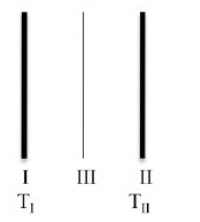
Two infinitely large parallel plates (I and II) are held at temperatures $T_I$ and $T_{II}$ ($T_I > T_{II}$) respectively, and placed at a distance $2d$ apart in vacuum. An infinitely large flat radiation shield (III) is placed in parallel in between I and II. The emissivities of all the plates are equal. The ratio of the steady state radiative heat fluxes with and without the shield is:
- Two very large parallel walls (gray bodies) facing each other have emissivities of 0.5 and 0.7. The view factor between these two walls is ________.
- The space between two hollow concentric spheres of radii 0.1 m and 0.2 m is under vacuum.
Exchange of radiation (uniform in all directions) occurs only between the outer surface ($S_1$) of the smaller sphere and the inner surface ($S_2$) of the larger sphere. The fraction (rounded off to the second decimal place) of the radiation energy leaving $S_2$, which reaches $S_1$ is


