
Kirchhoff's Identity Explained
Kirchhoff's Law of Thermal Radiation establishes a fundamental connection between how a body emits and absorbs thermal radiation.
The law specifically applies when a body is in thermal equilibrium with its surroundings. In this state, the condition of the body is stable, and there is no net flow of heat.
Applying Kirchhoff's Law
When a body is placed inside a perfectly black enclosure and reaches thermal equilibrium, its properties simplify:
- Emissivity ($\epsilon$): This measures how effectively a surface emits thermal radiation compared to a perfect blackbody at the same temperature and wavelength.
- Absorptivity ($\alpha$): This represents the fraction of incoming radiation at a specific wavelength that the body absorbs.
Under the conditions described (thermal equilibrium within a black enclosure), Kirchhoff's Law states that the emissivity of the body at any given wavelength is exactly equal to its absorptivity at that same wavelength.
Mathematically, this is expressed as:
$ \epsilon(\lambda, T) = \alpha(\lambda, T) $
Therefore, according to Kirchhoff's identity, the absorptivity of the body at a given wavelength equals its emissivity.
Important Questions from Radiation
Thermal radiation takes place at a surface which has reflectivity of 0.55 and a transmissivity of 0.032. What is the value of absorptivity?
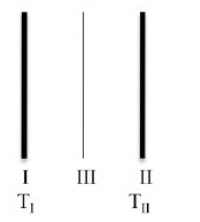
Two infinitely large parallel plates (I and II) are held at temperatures $T_I$ and $T_{II}$ ($T_I > T_{II}$) respectively, and placed at a distance $2d$ apart in vacuum. An infinitely large flat radiation shield (III) is placed in parallel in between I and II. The emissivities of all the plates are equal. The ratio of the steady state radiative heat fluxes with and without the shield is:
- Two very large parallel walls (gray bodies) facing each other have emissivities of 0.5 and 0.7. The view factor between these two walls is ________.
- The space between two hollow concentric spheres of radii 0.1 m and 0.2 m is under vacuum.
Exchange of radiation (uniform in all directions) occurs only between the outer surface ($S_1$) of the smaller sphere and the inner surface ($S_2$) of the larger sphere. The fraction (rounded off to the second decimal place) of the radiation energy leaving $S_2$, which reaches $S_1$ is - Given that $E$ (in $W.m^{-2}$) is the total hemispherical emissive power of a surface maintained at a certain temperature, which of the following statements is/are CORRECT?


