
Two infinitely large parallel plates (I and II) are held at temperatures $T_I$ and $T_{II}$ ($T_I > T_{II}$) respectively, and placed at a distance $2d$ apart in vacuum. An infinitely large flat radiation shield (III) is placed in parallel in between I and II. The emissivities of all the plates are equal. The ratio of the steady state radiative heat fluxes with and without the shield is: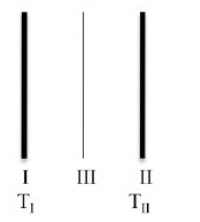
To find the ratio of the steady state radiative heat fluxes with and without the shield, we need to analyze the heat transfer between the plates.
Without the Shield:
- Consider the two plates I and II with temperatures \(T_I\) and \(T_{II}\), respectively.
- The net radiative heat flux \(q_{\text{without}}\) between two infinitely large parallel plates is given by:
\(q_{\text{without}} = \frac{\sigma \epsilon (T_I^4 - T_{II}^4)}{(1/\epsilon + 1/\epsilon - 1)}\)
Since the emissivities are equal and denoted by \(\epsilon\), the expression simplifies to:
\(q_{\text{without}} = \frac{\sigma \epsilon (T_I^4 - T_{II}^4)}{2 - \epsilon}\)
With the Shield:
- The radiation shield introduces additional surfaces. Consider each section separately:
- Between Plate I and Shield (III):
\(q_{I-III} = \frac{\sigma \epsilon (T_I^4 - T_3^4)}{(1/\epsilon + 1/\epsilon - 1)}\)
- Between Shield (III) and Plate II:
\(q_{III-II} = \frac{\sigma \epsilon (T_3^4 - T_{II}^4)}{(1/\epsilon + 1/\epsilon - 1)}\)
In steady state, \(q_{I-III}\) = \(q_{III-II}\). We can write:
\(q_{\text{with}} = \frac{\sigma \epsilon (T_I^4 - T_{II}^4)}{2(2 - \epsilon)}\)
Ratio of Heat Fluxes:
Now, find the ratio of heat fluxes with and without the shield:
\(\text{Ratio} = \frac{q_{\text{with}}}{q_{\text{without}}} = \frac{\frac{\sigma \epsilon (T_I^4 - T_{II}^4)}{2(2 - \epsilon)}}{\frac{\sigma \epsilon (T_I^4 - T_{II}^4)}{2 - \epsilon}} = \frac{1}{2}\)
Thus, the ratio of the steady state radiative heat fluxes with and without the shield is 0.5.
This corresponds to the correct answer option:
- 0.5
Important Questions from Radiation
- A body is placed inside a perfectly black enclosure and is allowed to reach thermal equilibrium. According to the Kirchhoff’s identity, which one of the following is equal to the emissivity of the body at a given wavelength?
Thermal radiation takes place at a surface which has reflectivity of 0.55 and a transmissivity of 0.032. What is the value of absorptivity?
- Two very large parallel walls (gray bodies) facing each other have emissivities of 0.5 and 0.7. The view factor between these two walls is ________.
- The space between two hollow concentric spheres of radii 0.1 m and 0.2 m is under vacuum.
Exchange of radiation (uniform in all directions) occurs only between the outer surface ($S_1$) of the smaller sphere and the inner surface ($S_2$) of the larger sphere. The fraction (rounded off to the second decimal place) of the radiation energy leaving $S_2$, which reaches $S_1$ is - Given that $E$ (in $W.m^{-2}$) is the total hemispherical emissive power of a surface maintained at a certain temperature, which of the following statements is/are CORRECT?


