
Identify Geometric Parameters
The problem specifies two parallel plane square surfaces with the following characteristics:
- Side length: $s = 4 \text{ mm} = 0.004 \text{ m}$
- Distance between centers: $L = 0.5 \text{ m}$
- Angle between the line connecting centers and surface normals: $\alpha = 30^\circ$
Calculate Surface Area
The area ($A$) of each square surface is calculated as:
$A = s^2 = (0.004 \text{ m})^2 = 1.6 \times 10^{-5} \text{ m}^2$
Determine View Factor using Approximation
Given that the surfaces are small compared to the separation distance ($s \ll L$), and considering the angle $\alpha$ between the line of centers and the surface normals, the view factor ($F_{12}$) can be approximated. The geometry suggests an approximation related to the projected area and distance:
$F_{12} \approx \frac{A \cos^2 \alpha}{\pi L^2}$
Compute View Factor Value
Substitute the known values into the approximation formula:
- $A = 1.6 \times 10^{-5} \text{ m}^2$
- $\cos \alpha = \cos 30^\circ = \frac{\sqrt{3}}{2}$, so $\cos^2 \alpha = \left(\frac{\sqrt{3}}{2}\right)^2 = \frac{3}{4} = 0.75$
- $L = 0.5 \text{ m}$
The calculation proceeds as follows:
$F_{12} \approx \frac{(1.6 \times 10^{-5} \text{ m}^2) \times 0.75}{\pi (0.5 \text{ m})^2}$
$F_{12} \approx \frac{1.2 \times 10^{-5}}{\pi \times 0.25}$
$F_{12} \approx \frac{1.2 \times 10^{-5}}{0.785398...}$
$F_{12} \approx 1.5278 \times 10^{-5}$
Rounding to three significant figures gives $1.53 \times 10^{-5}$.
Important Questions from Radiation
- A body is placed inside a perfectly black enclosure and is allowed to reach thermal equilibrium. According to the Kirchhoff’s identity, which one of the following is equal to the emissivity of the body at a given wavelength?
Thermal radiation takes place at a surface which has reflectivity of 0.55 and a transmissivity of 0.032. What is the value of absorptivity?
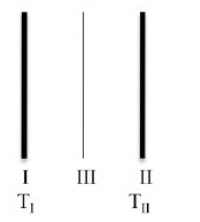
Two infinitely large parallel plates (I and II) are held at temperatures $T_I$ and $T_{II}$ ($T_I > T_{II}$) respectively, and placed at a distance $2d$ apart in vacuum. An infinitely large flat radiation shield (III) is placed in parallel in between I and II. The emissivities of all the plates are equal. The ratio of the steady state radiative heat fluxes with and without the shield is:
- Two very large parallel walls (gray bodies) facing each other have emissivities of 0.5 and 0.7. The view factor between these two walls is ________.
- The space between two hollow concentric spheres of radii 0.1 m and 0.2 m is under vacuum.
Exchange of radiation (uniform in all directions) occurs only between the outer surface ($S_1$) of the smaller sphere and the inner surface ($S_2$) of the larger sphere. The fraction (rounded off to the second decimal place) of the radiation energy leaving $S_2$, which reaches $S_1$ is


