
Two different positions of the same die are shown below. What is the number on the face opposite to the one having 6?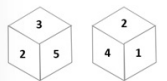
The question presents two images showing different orientations of a six-sided die. To determine the number opposite 6, we need to analyze the spatial relationship between the visible faces in both images.
Observe the common faces in both images. In the first image we see 6, 4, 3 and 1 and in the second image we see 6, 5, 2 and 1. Note that the number 1 is adjacent to the number 6 in both images. This is a key observation. Now let's consider the principle of opposite faces of a die: the sum of opposite faces always equals 7. Since the opposite face of number 1 is 6, this confirms the die is standard. Applying this principle, the number opposite 6 must be \(7 - 6 = 1\). However, this is not one of the options.
Let's analyze the adjacency of the visible numbers more closely. In both images, 1 is adjacent to 6. Now, notice the faces adjacent to 6 in the two images. In the first image, the adjacent faces to 6 are 4, 3, and 1. In the second image, the adjacent faces to 6 are 5, 2, and 1. Eliminating the common number 1 and comparing the remaining numbers, we can deduce which number is opposite 6. Since 4, 3, 5, and 2 are all adjacent to 6 in one image or another, the remaining number 2 must be the opposite face. This is possible if the die is arranged in a way where not all opposite sides necessarily add up to 7.
Therefore, the number on the face opposite to the one having 6 is 2.
Similar Questions
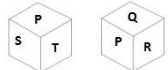
Six letters P, Q, R, S, T and U are written on different faces of a dice. Two positions of this dice are shown in the following figure. Find the letter on the face opposite to to S.
Two different positions of the same die are shown below. What is the number on the face opposite to the one having 2?
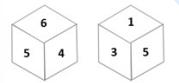
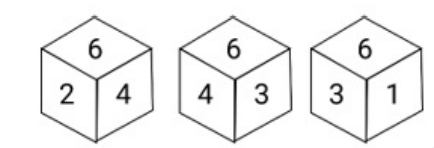
Three different positions of the same dice are shown. Find the number on the face opposite the face showing the number ‘4’.
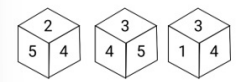
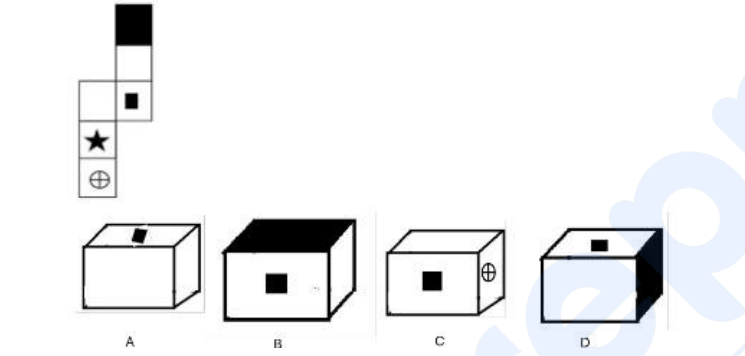
Select the possible cubes that can be formed by folding the given sheet.
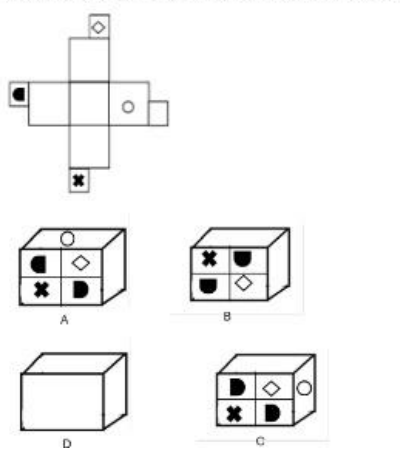
Select the possible cubes that can be formed by folding the given sheet.
Three different positions of the same dice are shown. Find the number on the face opposite the face showing the number '6'.
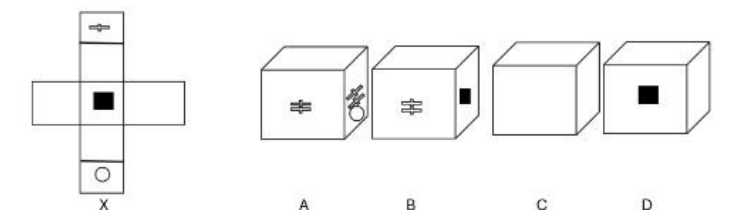
Choose the box that is similar to the box formed from the given sheet of paper (x).
Important Questions from Cube, cuboid and Dice
Each of the six different faces of a cube has been coated with a different colour i.e., V, I, B, G, Y and O.
Following information is given:
1) Colours Y, O and B are on adjacent faces.
2) Colours I, G and Y are on adjacent faces.
3) Colours B, G and Y are on adjacent faces.
4) Colours O, V and B are on adjacent faces.
Which is the colour of the face opposite to the face coloured with O?
Three views of a cube following a particular motion are given below:
What is the letter opposite to A?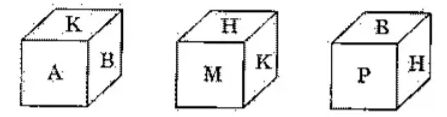
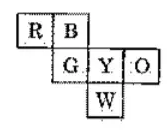
Six squares are coloured, front and back, red (R), blue (B), yellow (Y), green (G), white (W) and orange (0) and are hinged together as shown in the figure given below. If they are folded to form a cube, what would be the face opposite the white face?
A cuboid has six sides of different colours. The red side is opposite to black. The blue side is adjacent to white. The brown side is adjacent to blue. The red side is face down. Which one of the following would be the opposite of brown?
A cube has six numbers marked 1, 2, 3, 4, 5 and 6 on its faces. Three views of the cube are shown below:
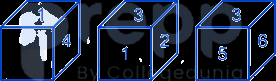
What possible numbers can exist on the two faces marked and respectively on the cube?




