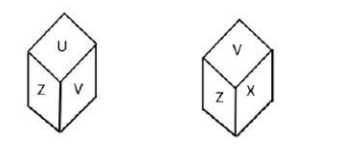
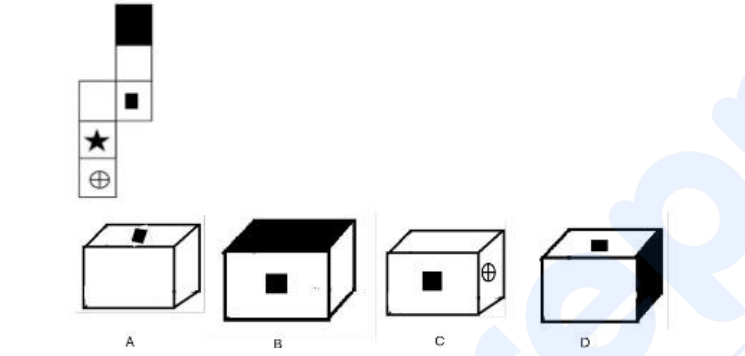
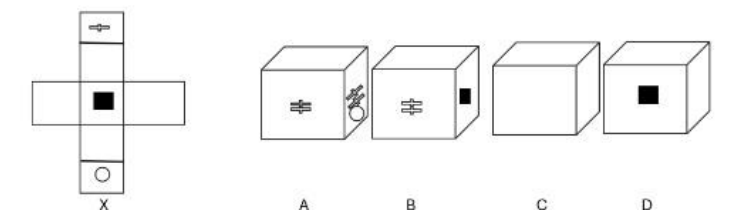
Select the possible cubes that can be formed by folding the given sheet.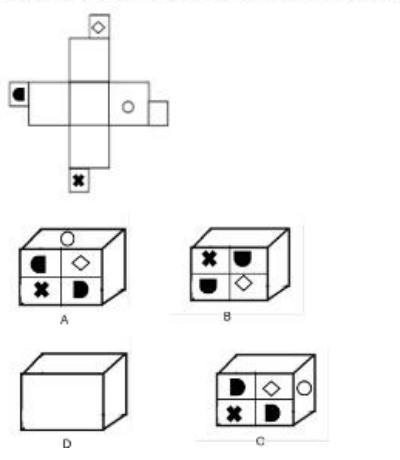
To determine which cubes can be formed by folding the given sheet, we need to understand how the faces of the sheet relate to each other when folded into a cube.
In the given unfolded cube (net), the positions and potential adjacent faces are as follows:
- Circle and cross are opposite to each other.
- Diamond and blank space are opposite to each other.
- Two half-black faces are opposite to each other.
Let's analyze the options:
- Option A: The cube shows adjacent faces with a circle next to a diamond. According to the net, a circle and diamond cannot be adjacent. Thus, this configuration is not possible.
- Option B: The cube shows a circle adjacent to a cross, which is correct as they can be on adjacent sides. This configuration is possible.
- Option C: The cube shows a diamond adjacent to a blank space. This is possible because the diamond and blank faces can be adjacent in the folded cube.
- Option D: Shows two half-black faces on adjacent sides, which is correct as one half-black can fold with another. This configuration is possible.
Thus, the correct cubes that can be formed are given by B, C, and D only.
Therefore, the correct answer is: B, C, D only.
Similar Questions
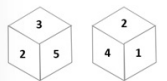
Two different positions of the same die are shown below. What is the number on the face opposite to the one having 6?
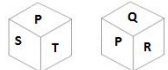
Six letters P, Q, R, S, T and U are written on different faces of a dice. Two positions of this dice are shown in the following figure. Find the letter on the face opposite to to S.
Two different positions of the same die are shown below. What is the number on the face opposite to the one having 2?
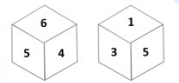
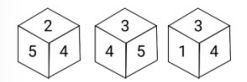
Three different positions of the same dice are shown. Find the number on the face opposite the face showing the number ‘4’.
Select the possible cubes that can be formed by folding the given sheet.
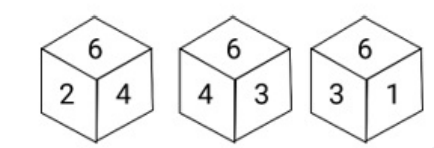
Three different positions of the same dice are shown. Find the number on the face opposite the face showing the number '6'.
Choose the box that is similar to the box formed from the given sheet of paper (x).
Important Questions from Cube, cuboid and Dice
Two different positions of the same die are shown below. What is the number on the face opposite to the one having 6?
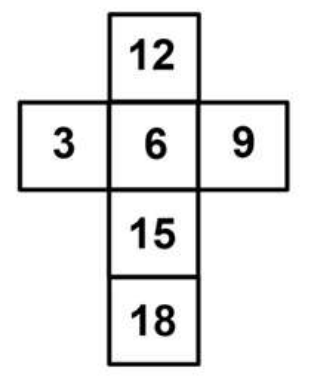
On folding the given die, which number will be opposite to the number 12?
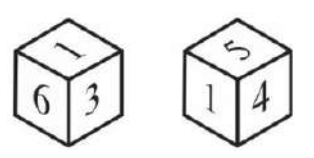
Two positions of a dice are given below. What will come on the face opposite to the face containing '6' on it?
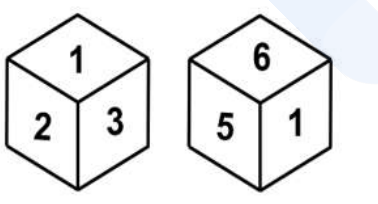
Two different positions of the same dice are given below. Find the number opposite of 2.
Two different positions of the same dice are shown having alphabets U to Z. Find the alphabet on the face opposite the face showing 'U'.