Adjacent Angles Setup
Let the smaller angle be $x$ and the larger angle be $y$. The problem states two conditions:
- The sum of the two adjacent angles is $100^{\circ}$: $x + y = 100^{\circ}$.
- The larger angle ($y$) is $20^{\circ}$ less than five times the smaller angle ($x$): $y = 5x - 20^{\circ}$.
Solving for the Angles
We can solve this system of two equations. Substitute the expression for $y$ from the second equation into the first equation:
$x + (5x - 20^{\circ}) = 100^{\circ}$
Combine like terms:
$6x - 20^{\circ} = 100^{\circ}$
Add $20^{\circ}$ to both sides:
$6x = 120^{\circ}$
Divide by 6 to find the smaller angle:
$x = \frac{120^{\circ}}{6} = 20^{\circ}$
Calculating the Larger Angle
Now substitute the value of $x$ back into the equation for $y$:
$y = 5x - 20^{\circ}$
$y = 5(20^{\circ}) - 20^{\circ}$
$y = 100^{\circ} - 20^{\circ}$
$y = 80^{\circ}$
The larger angle is $80^{\circ}$.
Verification
Check if the conditions are met:
- Sum: $20^{\circ} + 80^{\circ} = 100^{\circ}$ (Correct)
- Relationship: $5(20^{\circ}) - 20^{\circ} = 100^{\circ} - 20^{\circ} = 80^{\circ}$ (Correct)
The larger angle is $80^{\circ}$.
Similar Questions
- The measure of an angle is one half of its supplementary angle. Find its measure.
- The sum of two angles is $155^\circ$ and their difference is $\frac{\pi}{2}$. The value of the greater angle (in radians) is:
- The measure of an angle is three times the measure of its complement. The angles are respectively:
- The supplement of $70^\circ$ is:
- The cost price of 120 g of rice is the same as the selling price of 150 g of it. The percentage loss is:
- Which native Indian dynasty issued their own coins with portraits of their rulers on them?
- The angle formed by the pages of a fully open book, with just few pages, is theoretically:
What is the sum of the angle complementary to $15^\circ$ and the angle supplementary to $125^\circ$?
- When an arm of an angle is extended to double its length, then the measure of the angle:
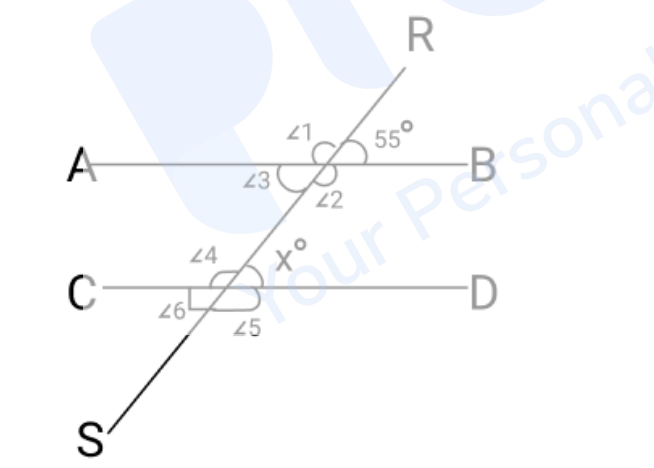
In the given figure, AB is parallel to CD and RS is a transversal. Find the value of X.
Important Questions from Lines and Angles
Two parallel lines are intersected by a transversal, the corresponding angles are:
If l, m, n are lines such that, l is parallel to n and m is parallel to n, then, ______
There are three points P, Q and R on a straight line such that PQ : QR = 3 : 5. If n is the number of possible values of PQ : PR, then what is n equal to ?
Two cars start from a point at the same time and travel on two different roads at right angles to each other. Their speed is 18 km/h and 72 km/h respectively. What will be the distance between them after 6 seconds?
If angles of a triangle are in the ration of 2 : 3 : 4, then the measure of the smallest angle is: