
Transduction of mechanical energy into nerve impulses in the auditory system takes place in reponse to bending of the _____________.
Understanding Auditory Transduction
Transduction in the auditory system is the crucial process where the mechanical energy of sound waves is converted into electrical signals (nerve impulses) that the brain can interpret as sound.
The Role of Hair Cells in Transduction
This complex conversion happens within the inner ear. Sound vibrations cause movement in the fluids of the cochlea. This movement, in turn, physically bends tiny, hair-like projections called stereocilia that sit atop specialized sensory cells known as hair cells.
The bending of these stereocilia is the direct trigger for transduction. It causes mechanically-gated ion channels in the hair cells to open or close, changing the electrical potential across the cell membrane. This electrical signal is then transmitted to the auditory nerve, ultimately reaching the brain.
Therefore, the bending of the hair cells (specifically, their stereocilia) is where mechanical energy is transduced into nerve impulses.
Analyzing Other Options
- Pinna: This is the outer part of the ear that collects sound waves but does not perform transduction.
- Incus and Malleus: These are small bones in the middle ear that transmit sound vibrations from the eardrum to the inner ear. They amplify sound but do not perform the final transduction into nerve signals.
Important Questions from Biological Basis of Behaviour Sensory Systems
Match the numbered parts of the vocal tract (in the diagram given below) with the correct label from those given in the box and choose the appropriate option.
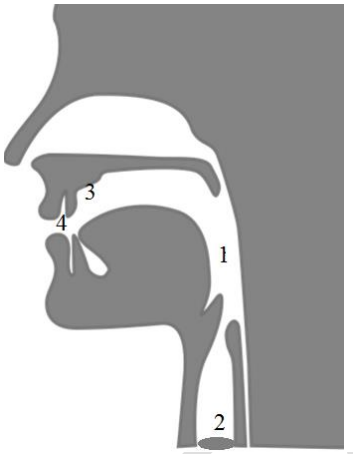
LABELS
a. Labial cavity
b. Pharyngeal cavity
c. Alveolar ridge
d. Laryngeal cavity- In the Darwinian sense, ________ refers to the ability of an organism to survive and produce a large number of fertile offspring.
- Comparing the thoughts of Heraclitus and Parmenides, we can say that:
- In his Yogasūtra, Patañjali mentions five kinds of afflictions (kleśas). Which one of the following is NOT among the five afflictions?
- Devanagari organizes the consonant graphemes as shown in the image. What is the parameter by which the following two rows differ?
क ख ग घ ङ /k/ /kʰ/ /g/ /gʰ/ /ŋ/ प फ ब भ म /p/ /pʰ/ /b/ /bʰ/ /m/


