
The "Thermal Transmittance" is also known as
Thermal Transmittance Explained
This question asks for an alternative name for "Thermal Transmittance". Thermal transmittance is a crucial concept used to measure how well heat travels through a building component, like a wall or a window. It essentially quantifies the rate of heat transfer across a unit area of a structure for a unit temperature difference.
Understanding Thermal Transmittance
Thermal transmittance measures how easily heat passes through a material or a composite structure. A higher value indicates that heat can pass through more readily, suggesting poorer insulation properties. The unit for thermal transmittance is typically Watts per square meter per Kelvin ($W/(m^2 \cdot K)$).
The Equivalent Term: Overall Heat Transfer Coefficient
The term "Thermal Transmittance" is commonly used interchangeably with the Overall heat transfer coefficient. This coefficient is often represented by the symbol 'U' or referred to as the U-value. Both terms describe the same characteristic: the overall ability of a building element to conduct heat.
A lower U-value indicates better insulating performance (less heat transfer), whereas a higher U-value suggests less effective insulation (more heat transfer). The calculation involves considering conduction, convection, and radiation across all layers of the component.
Evaluating Other Options
- Energy: Energy refers to the capacity to do work. While heat transfer involves energy, "energy" itself is not a measure of transmittance.
- Mass transfer: This term relates to the movement of substances (mass) from one place to another, which is distinct from heat transfer.
- Radiation: Radiation is one of the primary modes of heat transfer, alongside conduction and convection. Thermal transmittance encompasses the effects of radiation but is not synonymous with it.
Summary
Based on the definitions, the Overall heat transfer coefficient is the correct alternative name for Thermal Transmittance.
Important Questions from Radiation
- A body is placed inside a perfectly black enclosure and is allowed to reach thermal equilibrium. According to the Kirchhoff’s identity, which one of the following is equal to the emissivity of the body at a given wavelength?
Thermal radiation takes place at a surface which has reflectivity of 0.55 and a transmissivity of 0.032. What is the value of absorptivity?
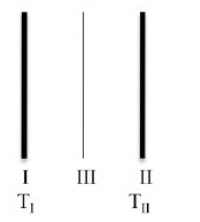
Two infinitely large parallel plates (I and II) are held at temperatures $T_I$ and $T_{II}$ ($T_I > T_{II}$) respectively, and placed at a distance $2d$ apart in vacuum. An infinitely large flat radiation shield (III) is placed in parallel in between I and II. The emissivities of all the plates are equal. The ratio of the steady state radiative heat fluxes with and without the shield is:
- Two very large parallel walls (gray bodies) facing each other have emissivities of 0.5 and 0.7. The view factor between these two walls is ________.
- The space between two hollow concentric spheres of radii 0.1 m and 0.2 m is under vacuum.
Exchange of radiation (uniform in all directions) occurs only between the outer surface ($S_1$) of the smaller sphere and the inner surface ($S_2$) of the larger sphere. The fraction (rounded off to the second decimal place) of the radiation energy leaving $S_2$, which reaches $S_1$ is


