
The temperature at which the resistance of a conductor becomes 30% more than that of its resistance at 47°C will be: (Given the value of the temperature coefficient of resistance of the conductor is 2 × 10⁻⁴ K-1.)
1820 K
Understanding Temperature Dependence of Resistance
The electrical resistance of a conductor changes with temperature. For most metallic conductors, resistance increases as temperature increases. This relationship can be described using the temperature coefficient of resistance.
Analyzing the Given Problem
We are given the following information:
- Initial temperature, \(T_0 = 47^\circ C\).
- Temperature coefficient of resistance, \(\alpha = 2 \times 10^{-4} K^{-1}\).
- The final resistance, \(R_T\), is 30% more than the initial resistance, \(R_{T_0}\).
We need to find the final temperature, \(T\), at which this resistance increase occurs.
Formula for Temperature Dependence of Resistance
The resistance of a conductor at a temperature \(T\) can be related to its resistance at a reference temperature \(T_0\) using the formula:
\(R_T = R_{T_0} [1 + \alpha (T - T_0)]\)
Where:
- \(R_T\) is the resistance at temperature \(T\).
- \(R_{T_0}\) is the resistance at the reference temperature \(T_0\).
- \(\alpha\) is the temperature coefficient of resistance.
- \(T - T_0\) is the change in temperature.
Step-by-Step Calculation
Convert Initial Temperature to Kelvin
The temperature coefficient is given in \(K^{-1}\), so we should work with temperatures in Kelvin. We convert the initial temperature \(T_0\) from Celsius to Kelvin by adding 273:
\(T_0 = 47^\circ C + 273 = 320 K\)
Express the Final Resistance
The problem states that the final resistance \(R_T\) is 30% more than the initial resistance \(R_{T_0}\). This can be written as:
\(R_T = R_{T_0} + 0.30 R_{T_0}\)
\(R_T = 1.30 R_{T_0}\)
Substitute Values into the Formula
Now, substitute this relationship for \(R_T\) into the temperature dependence formula:
\(1.30 R_{T_0} = R_{T_0} [1 + \alpha (T - T_0)]\)
Simplify the Equation
We can divide both sides of the equation by \(R_{T_0}\) (assuming \(R_{T_0}\) is not zero, which is true for a conductor):
\(1.30 = 1 + \alpha (T - T_0)\)
Isolate the Temperature Difference Term
Subtract 1 from both sides:
\(1.30 - 1 = \alpha (T - T_0)\)
\(0.30 = \alpha (T - T_0)\)
Substitute the Value of Alpha
Substitute the given value of \(\alpha = 2 \times 10^{-4} K^{-1}\):
\(0.30 = (2 \times 10^{-4} K^{-1}) (T - 320 K)\)
Solve for the Temperature Difference (T - T₀)
Divide 0.30 by \(\alpha\):
\(T - 320 K = \frac{0.30}{2 \times 10^{-4} K^{-1}}\)
\(T - 320 K = \frac{0.30}{0.0002} K\)
\(T - 320 K = \frac{3000}{2} K\)
\(T - 320 K = 1500 K\)
Solve for the Final Temperature (T)
Add 320 K to both sides:
\(T = 1500 K + 320 K\)
\(T = 1820 K\)
Thus, the temperature at which the resistance of the conductor becomes 30% more than its resistance at 47°C is 1820 K.
Summary of Results
| Parameter | Value |
|---|---|
| Initial Temperature (\(T_0\)) | 47°C or 320 K |
| Temperature Coefficient (\(\alpha\)) | \(2 \times 10^{-4} K^{-1}\) |
| Resistance Increase | 30% |
| Final Resistance (\(R_T\)) | \(1.30 \times R_{T_0}\) |
| Calculated Final Temperature (\(T\)) | 1820 K |
Revision Table: Conductor Resistance and Temperature
Here's a quick summary of the relationship between temperature and conductor resistance:
| Concept | Description | Formula Snippet |
|---|---|---|
| Temperature Dependence | Resistance of most conductors increases with increasing temperature. | Related to \(R_T = R_{T_0} [1 + \alpha (T - T_0)]\) |
| Temperature Coefficient (\(\alpha\)) | A material property indicating how much resistance changes per degree Celsius or Kelvin change in temperature. | Typically positive for metals. |
| Reference Temperature (\(T_0\)) | The temperature at which the initial resistance \(R_{T_0}\) is known. Often 0°C or 20°C or given as in the problem. | Used in the formula. |
Additional Information: Factors Affecting Electrical Resistance
Beyond temperature, the electrical resistance of a conductor depends on several physical characteristics:
- Material: Different materials have different inherent resistivities. Conductors like copper and aluminum have low resistivity, while insulators like rubber and glass have very high resistivity.
- Length (\(L\)): Resistance is directly proportional to the length of the conductor. A longer wire offers more resistance to current flow.
- Cross-sectional Area (\(A\)): Resistance is inversely proportional to the cross-sectional area. A thicker wire offers less resistance.
- Temperature (\(T\)): As discussed, temperature affects resistance, primarily for conductors. For semiconductors and insulators, the relationship can be different.
The resistance \(R\) of a uniform conductor can be expressed using resistivity (\(\rho\)) as:
\(R = \rho \frac{L}{A}\)
Resistivity \(\rho\) is the material property that changes with temperature, and \(\alpha\) describes how \(\rho\) changes with temperature, which in turn affects \(R\).
Important Questions from Current Electricity
Figure shows drift speed Vd of conduction electrons in a copper wire versus position (X) for the three sections. Then,
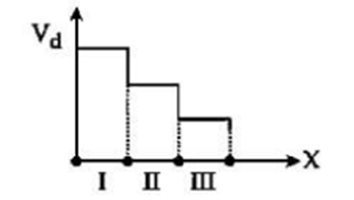
A. Radius of III > Radius of II > Radius of I
B. Electric Field in III > Electric Field in II > Electric Field in I
C. Radius of wire is same in all sections
D. Conductivity is same in all sections
Choose the correct answer from the options given below:
Which of the following circuits cannot be used to measure the resistance of resistor R?
Cell having an emf E and internal resistance r is connected across a variable external resistance R. As the resistance R is increased, the plot of potential difference V across R is given by:
In the potentiometer circuit, the balance point is at X. The balance point will be shifted right towards B when:
A. Resistance R is increased keeping all other parameters constant
B. Resistance S is increased keeping all other parameters constant
C. Cell P is replaced by another cell whose emf is lower than Q
D. The polarity of Q is reversed
Choose the correct answer from the options given below:
Kirchhoff’s First Law, ∑ I = 0 at a junction deals with conservation of:


