
Kirchhoff’s First Law, ∑ I = 0 at a junction deals with conservation of:
Charge
Understanding Kirchhoff's First Law and Conservation
Kirchhoff's First Law, also known as Kirchhoff's Current Law (KCL), is a fundamental principle in circuit analysis. It states that the algebraic sum of currents entering a junction (or node) in an electrical circuit is equal to zero. Mathematically, this is represented as \(\sum I = 0\).What is a Junction in a Circuit?
A junction, or node, is a point in an electrical circuit where three or more circuit elements are connected. It's essentially a branching point for current.Explaining Kirchhoff's First Law (\(\sum I = 0\))
The law means that the total current flowing into a junction must be equal to the total current flowing out of that junction. If we consider current entering a junction as positive and current leaving as negative (or vice versa), the sum of all currents at that point will be zero. Let's say a junction has currents \(I_1, I_2, ..., I_n\) connected to it. Some currents might be entering (\(I_{in}\)) and some might be leaving (\(I_{out}\)). Kirchhoff's First Law states:\(\sum I_{\text{entering}} = \sum I_{\text{leaving}}\)
Or, written as an algebraic sum:\(\sum_{\text{junction}} I = 0\)
Connecting KCL to Conservation Principle
Current (\(I\)) is defined as the rate of flow of electric charge (\(Q\)) per unit time (\(t\)).\(I = \frac{dQ}{dt}\)
If the total current entering a junction equals the total current leaving it, it implies that no electric charge is accumulating at the junction, nor is any charge being created or destroyed there. Charge simply flows through the junction, distributing itself among the different paths. This principle is a direct consequence of the conservation of electric charge. The total amount of electric charge in an isolated system remains constant. In the context of a circuit junction, the junction itself does not store or generate charge; it's merely a point of distribution. Therefore, the total charge flowing into the junction per unit time must equal the total charge flowing out of the junction per unit time.Analyzing the Options
Let's look at the given options in relation to Kirchhoff's First Law (\(\sum I = 0\)):- Charge: As explained above, KCL is a direct application of the conservation of electric charge. The law ensures that charge is neither gained nor lost at any junction in the circuit. This is consistent with the fundamental principle of charge conservation.
- Energy: Conservation of energy in a circuit is dealt with by Kirchhoff's Second Law, also known as Kirchhoff's Voltage Law (KVL), which relates to the sum of potential differences around a closed loop. KCL does not directly deal with energy conservation.
- Momentum: Momentum conservation is a principle related to motion and forces, typically applied in mechanics. It is not directly related to the flow of current or the principles governing electrical circuits at a junction.
- Angular Momentum: Angular momentum conservation is also a principle from mechanics, related to rotational motion. It has no application in the context of current distribution at an electrical junction.
Revision Table: Kirchhoff's Laws Summary
| Law | Statement | Formula | Deals with Conservation of |
|---|---|---|---|
| Kirchhoff's First Law (KCL) | The algebraic sum of currents at any junction is zero. | \(\sum I = 0\) | Electric Charge |
| Kirchhoff's Second Law (KVL) | The algebraic sum of potential differences (voltages) around any closed loop is zero. | \(\sum V = 0\) | Energy |
Additional Information on Circuit Laws
While Kirchhoff's First Law focuses on current at a junction based on charge conservation, Kirchhoff's Second Law complements it by focusing on voltage around a closed loop based on energy conservation. Understanding both laws is crucial for analyzing complex electrical circuits. KCL is applied at nodes or junctions, while KVL is applied to closed loops or meshes within a circuit. Together, these two laws provide a powerful toolset for solving circuit problems.Important Questions from Current Electricity
Figure shows drift speed Vd of conduction electrons in a copper wire versus position (X) for the three sections. Then,
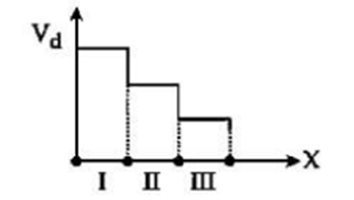
A. Radius of III > Radius of II > Radius of I
B. Electric Field in III > Electric Field in II > Electric Field in I
C. Radius of wire is same in all sections
D. Conductivity is same in all sections
Choose the correct answer from the options given below:
Which of the following circuits cannot be used to measure the resistance of resistor R?
The temperature at which the resistance of a conductor becomes 30% more than that of its resistance at 47°C will be:
(Given the value of the temperature coefficient of resistance of the conductor is 2 × 10⁻⁴ K-1.)
Cell having an emf E and internal resistance r is connected across a variable external resistance R. As the resistance R is increased, the plot of potential difference V across R is given by:
In the potentiometer circuit, the balance point is at X. The balance point will be shifted right towards B when:
A. Resistance R is increased keeping all other parameters constant
B. Resistance S is increased keeping all other parameters constant
C. Cell P is replaced by another cell whose emf is lower than Q
D. The polarity of Q is reversed
Choose the correct answer from the options given below:


