
The sum of the first $n$ terms in the sequence 8, 88, 888, 8888, ... is______.
Sequence Sum Formula Derivation
The given sequence is 8, 88, 888, 8888, ...
We need to find the sum of the first n terms, denoted by Sn.
Step 1: Express the Sequence Terms
The k-th term of the sequence can be written as:
$a_k = \underbrace{88...8}_{k \text{ times}}$
This can be rewritten as:
$a_k = 8 \times \underbrace{11...1}_{k \text{ times}}$
Step 2: Use Powers of 10
The sum of the first k ones, $\underbrace{11...1}_{k \text{ times}}$, can be expressed using the formula $\frac{10^k - 1}{9}$.
Therefore, the k-th term becomes:
$a_k = 8 \times \frac{10^k - 1}{9} = \frac{8}{9}(10^k - 1)$
Step 3: Formulate the Sum Sn
The sum of the first n terms is:
$S_n = \sum_{k=1}^{n} a_k = \sum_{k=1}^{n} \frac{8}{9}(10^k - 1)$
Factor out the constant $\frac{8}{9}$:
$S_n = \frac{8}{9} \sum_{k=1}^{n} (10^k - 1)$
Separate the sums:
$S_n = \frac{8}{9} \left( \sum_{k=1}^{n} 10^k - \sum_{k=1}^{n} 1 \right)$
Step 4: Apply Geometric Series Formula
The first part, $\sum_{k=1}^{n} 10^k$, is a geometric series with first term $a = 10$, common ratio $r = 10$, and n terms. The sum is $a \frac{r^n - 1}{r - 1} = 10 \frac{10^n - 1}{10 - 1} = \frac{10}{9}(10^n - 1)$.
The second part, $\sum_{k=1}^{n} 1$, is simply n.
Substitute these back into the expression for Sn:
$S_n = \frac{8}{9} \left( \frac{10}{9}(10^n - 1) - n \right)$
Step 5: Simplify the Expression
Distribute the $\frac{8}{9}$:
$S_n = \frac{8}{9} \times \frac{10}{9}(10^n - 1) - \frac{8}{9} \times n$
$S_n = \frac{80}{81}(10^n - 1) - \frac{8}{9}n$
This matches the formula presented in Option 4.
Important Questions from Series
The following figures show three curves generated using an iterative algorithm. The total length of the curve generated after 'Iteration n' is:
Note: The figures shown are representative.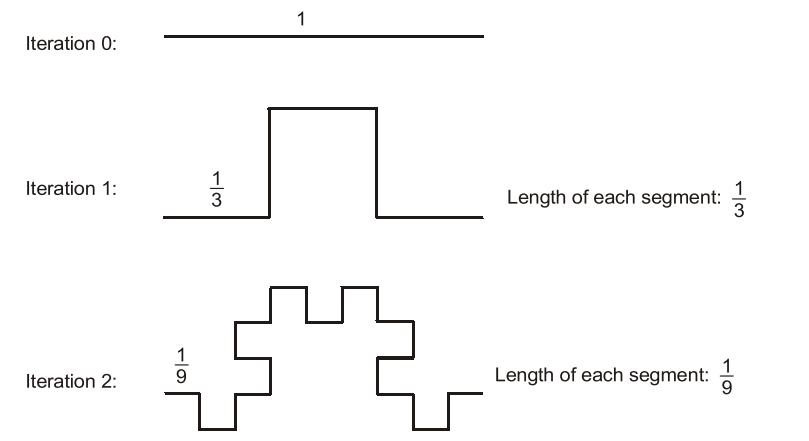
Let $a_0 = 0$ and define $a_n = \frac{1}{2}(1 + a_{n-1})$ for all positive integers $n \ge 1$.
The least value of $n$ for which $|1 - a_n| < \frac{1}{2^{10}}$ is __________.
(Answer in integer)
- In the sequence 6, 9, 14, $x$, 30, 41, a possible value of $x$ is
- The difference between the sum of the first $2n$ natural numbers and the sum of the first $n$ odd natural numbers is ______
Find the missing group of letters in the following series:
BC, FGH, LMNO, ____________


